
Many Mainers may not realize that one of the most consequential changes to the state’s energy policy in years is already law.
On June 20, 2025, Gov. Janet Mills signed LD 1868, now Public Law Chapter 386. The law moved Maine’s previous 2050 energy goal forward by an entire decade and requires that by 2040, 90% of retail electricity sales in Maine come from renewable resources, and another 10% come from qualifying “clean resources.” In other words, Maine has legally committed itself to a 100% clean-electricity sales standard by 2040.
To be precise, this does not mean every gallon of heating oil, gasoline or other form of energy consumed in Maine must be “clean” by 2040; it only applies to electricity sold at retail.
But that distinction hardly makes the policy insignificant. Maine is simultaneously encouraging greater electrification of heating and transportation, meaning policymakers are putting more of the state’s economy onto the electric grid while imposing increasingly strict requirements on what resources may supply that grid.
LD 1868 accomplishes this through two mandates. Maine’s Renewable Portfolio Standard, or RPS, will rise to 90% by 2040. A new Clean Energy Standard, or CES, begins phasing in during 2031 and reaches 10% in 2040. The clean category is broader than the renewable category and can include nuclear power, qualifying hydroelectric generation, and other sources meeting stringent emissions requirements. But 90% of the total remains reserved for resources qualifying under Maine’s renewable classifications.
The question Mainers should be asking is simple: What will this radical mandate cost?
Augusta Cannot Mandate Away the Cost
Earlier this year, Maine Policy Institute and other New England free-market organizations released Alternatives to New England’s Energy Affordability Crisis, a study examining several different ways the region could meet its future electricity needs. Its findings should make Maine lawmakers deeply uncomfortable with the direction they have chosen.
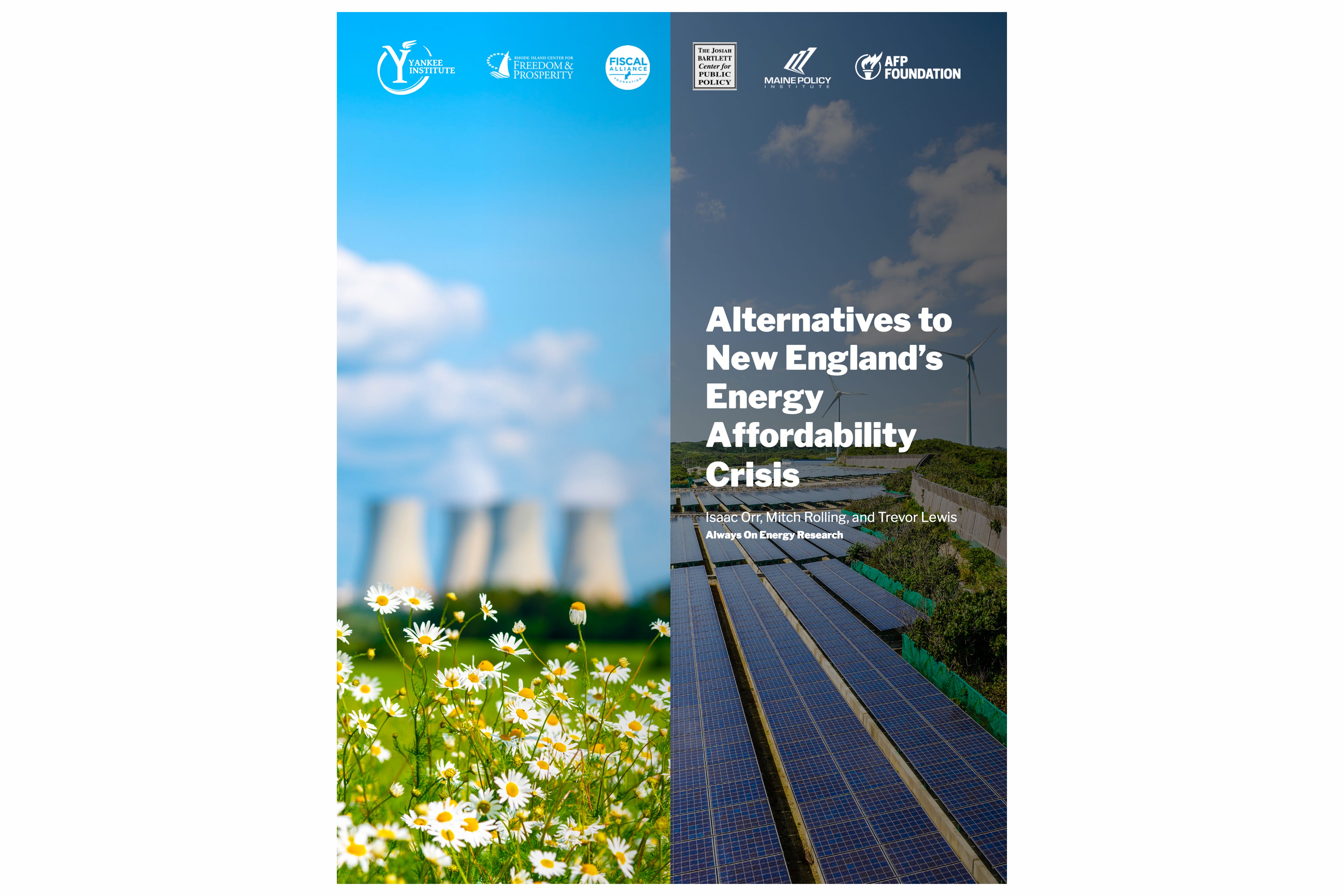
Increased electricity demand from electrification policies affecting home heating and transportation could boost overall New England electricity demand by 106%. Under the report’s renewable scenario, meeting this massive demand using renewables such as wind and solar, would incur approximately $815 billion in additional system costs through 2050 once you take into account battery storage and new transmission infrastructure.
In comparison, the same modeling projects significantly lower system costs for other generation scenarios, with the Nuclear scenario incurring $415.3 billion in additional costs, the “Happy Medium” combination of nuclear and natural gas incurring $195.8 billion in additional costs, and the Natural Gas scenario incurring only $106.9 billion in additional costs.
When changes in electricity prices are factored into household budgets, the estimated costs of the Renewable scenario become even more stark for average New England residential customers. In 2024, a family with an average annual bill of $2,100 per year for electricity would see an increase to approximately $4,610 annually by 2050 under the Renewable scenario, a jump of over $2,500 that would dramatically affect household budgets. By comparison, modeled annual bills under the Natural Gas, Happy Medium, and Nuclear scenarios are approximately $2,302, $2,569, and $3,339, respectively.
The reason for the cost difference is not difficult to understand. Electricity must be available when people need it, not merely when the wind is blowing or the sun is shining. The report estimates that its Renewable scenario would require approximately 225,400 megawatts of installed regional generating capacity by 2050, compared with roughly 60,000 megawatts in each of the three alternative scenarios. That means vastly more generation, storage, transmission and interconnection infrastructure must be built and paid for to serve the same customers. Ratepayers will ultimately be the ones left paying these costs.
Maine has chosen to move forward with those policies against the recommendations of an incredibly thorough and scientific study demonstrating what the harm would be. This should prompt a serious reconsideration of the approach, not an acceleration to go further. Such an approach must address the issues raised in the report.
Affordability Cannot Be an Afterthought
The Maine Department of Energy Resources is currently shaping the 2027 Maine Energy Plan, and asking for Mainers’ input via workshops, webinars, and an online stakeholder survey.
“Affordable” is listed first, among four major priorities identified on DOER’s website. Reliability, security and clean energy follow. But the next sentence states that Maine is legally required to increase renewable and clean electricity to 100 percent by 2040.
The irony is hard to miss: Augusta has already dictated the destination and is now asking Mainers how concerned they are about the price of getting there.
Ratepayers will ultimately be the ones left paying these costs.
To its credit, LD 1868 includes a limited cost safeguard. The Public Utilities Commission has authority to pause or delay scheduled increases in the new 10% Clean Energy Standard if compliance costs are driving up electricity prices without delivering enough new clean energy resources, and in some cases the law requires the Commission to do so. In practical terms, this means the state can temporarily stop the Clean Energy Standard from ratcheting upward as planned, but it does not eliminate the requirement itself. Importantly, that safeguard applies only to the Class III clean-energy requirement. It does not affect the much larger 90% Renewable Portfolio Standard that sits at the core of the 2040 mandate.
Meanwhile, in New Hampshire

In contrast to Maine, other states are starting to recognize the dangers these mandates could cause. In fact, last session legislators across the border in New Hampshire introduced and debated a bill to completely phase out renewable mandates. HB 219 was introduced in 2025 to phase out New Hampshire’s Renewable Portfolio Standard over five years, ultimately repealing the requirement by the end of 2030. Although the proposal ended up stalling in the Senate, it has been sent out to be studied, meaning this issue is still being seriously considered in New Hampshire.
In July, New Hampshire passed the productive legislation, HB 1775, that enables electric utilities to invest in certain natural gas and nuclear generation resources, and to seek recovery through rates for qualifying investments. The measure rightly identifies the importance of ensuring reliable, dispatchable, and controllable generation resources are available when renewable resources and storage can’t provide enough electricity.
On March 26, Gov. Kelly Ayotte issued Executive Order 2026-01, directing the New Hampshire Department of Energy to develop a roadmap for bringing next-generation nuclear generation to the state. Even more noteworthy, Ayotte’s office confirmed to the New Hampshire Bulletin that the order’s conclusion that greater use of nuclear power could lower electricity rates more effectively than greater reliance on renewable energy was based on the same 2026 study released by Maine Policy Institute and its coalition partners.
That makes the contrast with Maine especially striking. The research Augusta should be taking seriously as it races toward a 100% clean-electricity mandate is already helping shape policy in the state next door. New Hampshire is looking at the evidence and asking how it can expand reliable, dispatchable generation and lower costs. Maine is looking at the same regional affordability crisis and doubling down on mandates that restrict its options and are inevitably going to significantly raise costs for consumers.
Maine Should Reconsider This Disastrous Mandate
Maine lawmakers can reject this approach and advance policies that will actually lower energy costs and help keep the grid reliable. Rather than dictating which resources are able to compete, lawmakers should focus on the outcomes that will drive the best results for consumers.
A better energy policy would prioritize reliability and affordability, and allow technologies to compete on their merits. Nuclear power, natural gas, hydroelectricity, renewables, storage, and future technologies all should be welcome in that pursuit.
But LD 1868, our recent legislation committing us to 100% renewables by 2040, takes precisely the opposite approach. It reserves a vast share of the market for one particular technology, in this case seemingly endless rows of windmills and solar panels.
Instead of wasting resources on mandates, our lawmakers should revisit LD 1868 and our Renewable Portfolio Standard with an eye toward unwinding the mandate before the requirements begin to kick in.
Legislators should at a minimum commission a genuinely technology-neutral analysis comparing the cost and reliability of the statutory 90% renewable and 10% clean mandate, versus alternatives allowing greater use of dispatchable generation.
Better yet, Maine should repeal the rigid portfolio mandates and let the market sift through the wealth of options available for delivering reliable electricity and low cost. If it is possible to actually attain 100% clean electricity by 2040 at low cost to Maine consumers, that outcome has every reason to win on its own merits, without a mandate.
Like analyses like this? Support Maine Policy Institute and subscribe to our Substack page for analyses straight to your email inbox.