On April 16, U.S. Attorney General Pam Bondi announced that the federal government was suing Maine over violating the Trump administration’s executive orders interpreting Title IX. Maine’s Attorney General, Aaron Frey earlier this month issued a response to the Trump administration’s impasse letter claiming that various federal courts have held that Title IX and/or the equal protection clause require states to include transgender athletes in the sports teams of their choosing.
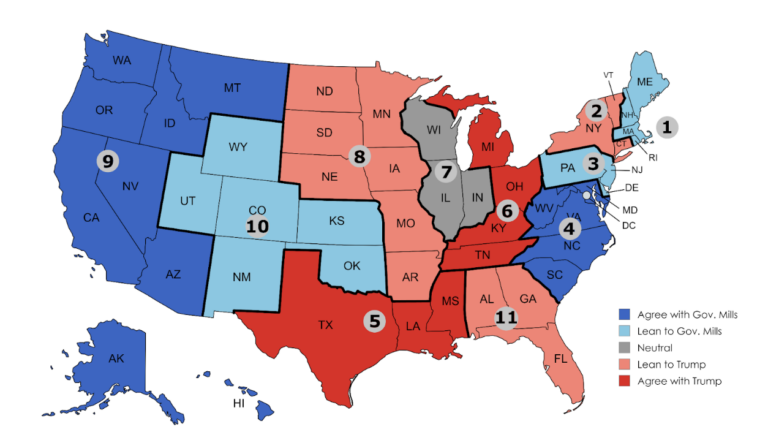
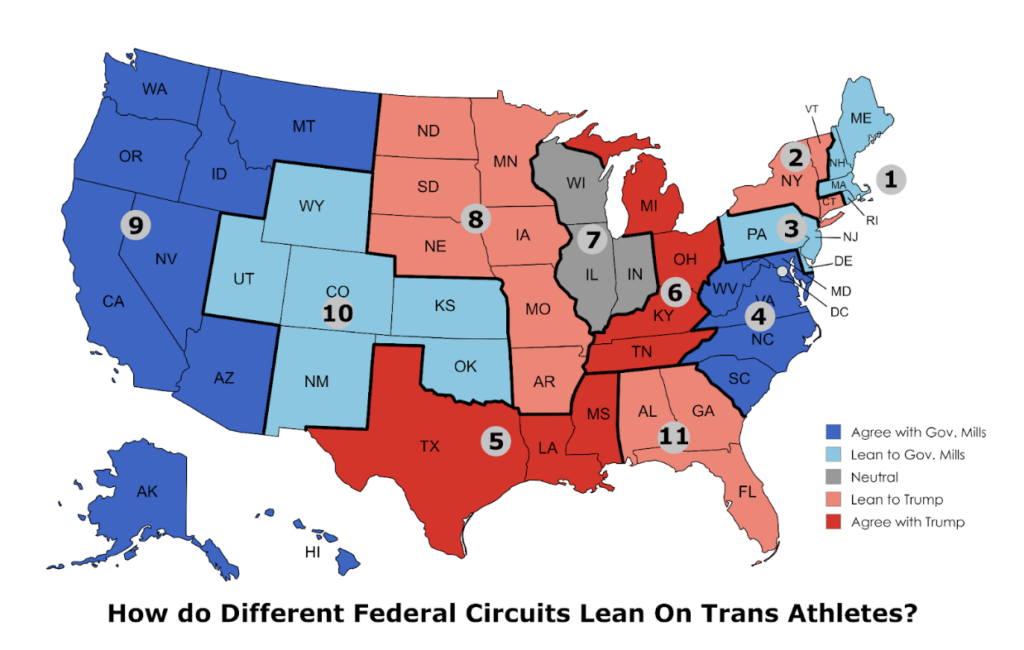
While the Maine Attorney General’s office is technically correct that certain federal circuits, namely two of the total thirteen, have ruled that way, many other federal courts have not. How courts have ruled on this issue in the past is a good indication of what the outcome of the Trump lawsuit’s will be. This blog post will provide a summary of each circuit’s position on the issue and the relevance of those rulings to the current case.
First Circuit: Most of New England
This is the best first stopping point for the analysis, as this is the circuit Maine is in. While Maine’s circuit is labelled “lean to Governor Mills,” this is not necessarily the final factor in who will win the Title IX lawsuit. The regions labeled as “lean Gov. Mills” are labeled that way because either the circuit courts in that area have ruled on issues closely related to the current case, or a few trial courts have ruled on the issue without the circuit courts intervening.
Relevant Cases:
- Tirell v. Edelblut (2024): Several New Hampshire families successfully filed a lawsuit against a state law banning trans girls in grades five and up from participating on female school sports teams. While a trial court issued a preliminary injunction, citing that the law as applied violated Title IX and the Equal Protection Clause, a trial court ruling has little binding precedent in Maine. Also of note is that the court did not declare the law unconstitutional as a whole, only as applied in that case.
Second Circuit: New York, Connecticut, Vermont
Here, we begin to see that Maine leadership’s narrative that the law is on their side becomes a bit more complicated. This is a very left-leaning circuit, as all three of these states are considered strongholds for the Democratic Party. However, the Second Circuit leans towards supporting Trump.
Relevant Cases:
- Soule v. Connecticut (2023): This was not a final ruling, which is why this circuit is labelled lean rather than full support. In this case, several female athletes sued Connecticut, claiming the state policy of forcing them to compete against trans athletes violated Title IX. The trial court dismissed their case, claiming that they had not suffered any injury and therefore could not sue. However, the circuit court said it was possible the Connecticut law had injured them. The appellate court then remitted the case back to trial to determine the facts, meaning that this circuit at least entertained the possibility that there was competitive harm caused by the law.
Third Circuit: Delaware, Pennsylvania, New Jersey
This is a circuit that can be seen as either leaning in support of Maine’s position or remaining completely neutral. This circuit does not appear to have directly addressed trans athletes, but it has made rulings on a directly related issue which can be used to infer its position on the Trump case.
Relevant Cases:
- Doe v. Boyertown Area School District (2018): This is a case not regarding trans athletes, but trans students accessing bathrooms. The court in this case was very supportive of trans students’ inclusion in the bathrooms of their choosing, implying this circuit might rule similarly on trans athletes.
Fourth Circuit: Maryland, North Carolina, South Carolina, Virginia, West Virginia
The Fourth Circuit may be the greatest gift to Gov. Mills in this case, as it is one of the two federal circuit courts that have strongly agreed with her position. Additionally, the other circuit, the Ninth Circuit, is known as a political outlier due to its location on the West Coast. Thus, the Ninth Circuit’s ruling on its own would be taken far less seriously without this Fourth Circuit decision.
Relevant Cases:
- B.P.J. v. West Va. State Bd of Ed (2024): West Virginia was one of many states that passed a “Save Women’s Sports Act” (SWSA), which attempted to ban biological males from competing on women’s sports teams. Similar to the other state laws and the Trump executive order, the SWSA stopped biological males from joining women’s sports, but did not restrict which teams biological females could join. This court did not rule one way or the other on equal protection, but it did rule that the act violated Title IX by restricting which teams biological males can join, without doing the same for women. By restricting boys but not girls, the circuit court ruled that this law discriminated based on biological sex.
- A three-judge council decided this case two-to-one, and Judge G. Steven Agee (a Bush appointee) wrote a scathing dissent. In it, he argued that the majority had majorly misstepped by comparing the female athletes’ ability to join either team to the male athletes’ being forced to join only the boys’ team. He felt that the boys do not face the same disadvantages in co-ed sports, and that Title IX should not apply when no sex was put at an actual disadvantage.
Fifth Circuit: Louisiana, Mississippi, and Texas
This circuit is almost certainly siding with the Trump administration, as it is known for its conservative leanings. Additionally, all three states in this circuit have state-level bans on trans athletes in female students’ sports teams. The laws in Mississippi and Texas have been in place since 2021 without being successfully challenged, making them the second and tenth states to enact such a ban.
Relevant Cases:
- Department of Education v. Louisiana (2024): Louisiana, along with many other states, sued the Biden administration for attempting to institute new rules interpreting Title IX to require integration of trans students into bathrooms and locker rooms of their preference, along with other wide-reaching requirements. The Circuit Court supported the injunction, and when the Biden administration requested Certiorari (the Supreme Court’s version of appeal), the Supreme Court voted 5-4 to support the temporary stopping of the rule.
- Notable is the fact that Justice Neil Gorsuch, commonly considered a conservative Trump appointee, sided with the more left-leaning justices in this decision as he did in the relevant trans rights labor law case Bostock v. Clayton County.
- This case is indicative of the circuit’s widespread skepticism for extending Title IX protections to trans athletes. Thus, they would likely agree with the Trump administration’s interpretation of Title IX.
Sixth Circuit: Michigan, Kentucky, Ohio, and Tennessee
The Sixth Circuit’s precedence seems to side with Trump about as much as the Fifth Circuit does. Although we must again infer some from rulings on similar subjects, this circuit has explicitly ruled against the Biden administration’s interpretation that Title IX includes protection based on gender identity.
While this doesn’t necessarily mean that they agree with the idea that Title IX can be taken to imply a ban on trans athlete inclusion on sex-based teams, they have used incredibly similar language as the dissent in the Fourth Circuit case B.P.J. v. West Va. State Bd of Ed. That dissent noted that if Title IX did not explicitly refer to sex-based discrimination, then it was too vague to comply with the U.S. Constitution’s spending clause, which requires states to understand what they must do to receive federal funding. Since the dissent in B.P.J. held that “ensuring equal opportunities for biological girls in sports requires that they not have to compete against biological boys,” we can conclude that the Fourth Circuit’s similar language implies a similar position on this issue.
Relevant Cases:
- Tennessee v. Cardona (2025): Several states sued in the Sixth Circuit court to again enjoin the Biden administration from enforcing its gender-identity inclusive interpretation of Title IX. While this does not mean that the court necessarily agrees that Title IX protects female athletes from competing against males, their language aligns with the B.P.J. dissent heavily and supports the principle of using sex-based facilities under Title IX.
- “Conversely, the entire point of Title IX is to prevent discrimination based on sex—throwing gender identity into the mix eviscerates the statute and renders it largely meaningless.”
- “As the Court explained previously, several of the terms used in this regulation are so vague that recipients of Title IX funds have no way of predicting what conduct will violate the law.”
- “doesn’t it also subject such persons to harm when they are prevented from participating in the social fraternity or sorority consistent with their gender identity? […] It seems clear that the answer is “yes,” which indicates that Title IX does not encompass the issue of gender identity at all.”
Seventh Circuit: Illinois, Indiana, and Wisconsin
This circuit is listed as neutral, mainly because while it has touched on some issues, like transgender access to restrooms of their choice, it has not had many cases involving trans athletes. Additionally, while the Third Circuit has also largely ruled only on secondary issues, it is a much more left-leaning circuit. In contrast, the Seventh Circuit has Indiana, a state that banned biological males from female sports, and an appealed case was withdrawn before the decision was issued. This indicates fear among the law’s opponents that the circuit would side with Indiana. While some cases in this circuit lean towards trans-inclusivity, others heavily lean the other way, meaning that this circuit is undecided.
Relevant Cases:
- AM v. Indianapolis Public Schools (2023): Indiana, like many conservative states, passed a law restricting female sports teams to only biological females. A.M., an anonymous trans student, sued with the support of the ACLU. While the trial court granted a preliminary injunction, the state of Indiana appealed. Before the circuit could make a ruling, A.M. and the ACLU withdrew, and the student was placed in a charter school. This means the circuit did not get to review the appeal, but it might indicate that the plaintiffs were worried about how the court might rule. Alliance Defending Freedom did a summary of the case’s details.
- Again, the trial court only granted an injunction as applied, not against the law in its entirety.
Eighth Circuit: Much of the Midwest
This circuit is listed as leaning pro-Trump, and that is because, like the Eleventh and Second Circuits, no circuit rulings have been made directly on this issue yet. However, like the Eleventh Circuit, some rulings indicate how this circuit would rule. In particular, this circuit has ruled that a school district’s requirements to recognize preferred pronouns were unconstitutionally vague. Additionally, while the Biden administration was attempting to enforce trans-inclusive Title IX interpretations, a Missouri district court, although not an appellate court in the Eighth Circuit, issued a temporary injunction blocking the rule.
Relevant Cases:
- Parents Defending Education v. Linn-Mar Community School District (2024): Here, the Eighth Circuit ruled that a school district policy requiring preferred pronouns was unconstitutionally vague and violated the First Amendment. Even pronouns aren’t protected under Title IX in this circuit’s interpretation. Thus, it is likely, but not certain, that they would agree with the Trump administration’s interpretation of Title IX.
- Arkansas v. US DOE (2024): This is a case in which the attorneys general of Arkansas, Iowa, Missouri, Nebraska, North Dakota, and South Dakota successfully sued in a Missouri court to enjoin the Biden Title IX rules. This was the attorney general of every single state in the Eighth Circuit, minus Minnesota.
Ninth Circuit: The West Coast, Alaska, Arizona, Hawaii, Idaho, Montana, and Nevada
This is the only other circuit besides the fourth that has decisively ruled that Title IX protects trans students. This circuit is known for issuing incredibly left rulings; however, this should not be surprising. This is because California is by far the most populated state in the region, with Washington coming a distant second. More than 58% of the Ninth Circuit’s population lives in California, with another 18% living in Oregon and Washington, both of which are also known for being strongly left-leaning. Thus, this circuit is one of the strongest supporters in the Mills administration’s camp, and unlike the Fourth, this circuit had no dissent in one of the most analogous cases to the current lawsuit.
Relevant Cases:
- Doe v. Horne (2024) Similar to 24 other states, Arizona attempted to pass a state law similar to Trump’s executive order. However, both a district court and a circuit court in this circuit agreed with trans student plaintiffs that banning them from women’s sports teams violated both the equal protection clause and Title IX.
Tenth Circuit: Colorado, Kansas, New Mexico, Oklahoma, Utah, and Wyoming
This circuit is a mixed bag politically. Colorado and New Mexico are considered left learning states, while many of the others in this circuit are considered conservative, but have smaller populations. This circuit, however, appears to lean towards supporting Maine’s interpretation of antidiscrimination law, as there have been a few appellate cases with similar facts and a trans-inclusive ruling.
Relevant Cases:
- Slusser v. Mountain West Conference (2024): In this case, female athletes sued for being forced to compete with a biological male. Both the trial and the circuit court reviewing this case ruled against an emergency injunction, citing that they felt the balance of harms would hurt the trans athlete more from being removed than the female athletes from refusing to remove the trans athlete. They did, however, both mention that the lateness of the lawsuit was relevant, and the fact that it was regarding collegiate sports and involved other factors likely means this court is leaning only slightly towards Maine’s Title IX interpretation, rather than Trump’s.
- The appeals court noted that the female athletes’ claims “appear to present a substantial question and may have merit,” however, without any final rulings based on this belief, this circuit still appears to lean towards agreeing with Maine.
Eleventh Circuit: Alabama, Florida, Georgia
This is the last circuit we will be analyzing, as the final two tend to deal with more niche administrative cases. While technically no Eleventh Circuit Court rulings exist on this issue yet, there are several reasons this circuit is listed as leaning pro-Trump. First, this circuit has previously ruled that non-trans-inclusive bathroom policies are not a Title IX violation. This also employed similar spending clause arguments as the Fourth Circuit dissent. Additionally, this circuit has held that parents have no legal right to transition their children, further indicating skepticism of trans inclusive policies for minors.
Relevant Cases:
- Adams v. School Board of St. John’s County (2022): “The Adams court determined that the government’s proffered objective of ‘protecting students’ privacy interests in school bathrooms’ from students of the opposite sex was an important one, and that the policy of requiring students to use bathrooms aligned with their biological sex was ‘clearly related to’ this objective.”
- D.N. v. DeSantis (2023): This case in particular makes it close as to whether the circuit entirely or only partially agrees with Trump. Here, a trial court applied Adams, ruling that trans students should be compared to other students of their biological sex in discrimination cases. Thus, trans athletes weren’t being discriminated against. This did not cause us to classify the Eleventh Circuit as fully agreeing with Trump because this was only a trial court ruling, and the court did not explicitly state that Title IX establishes protection for girls competing against trans athletes, only that it doesn’t ban laws doing so.
- Eknes-Tucker v. Governor of Alabama (2023): This is a case where parents in Alabama sued the Governor due to state laws that stopped them from providing chemical treatment to trans people under the age of 19. While a trial court enjoined the state of Alabama from enforcing the law, the Eleventh Circuit ruled that parents have no right to transition their children, indicating further circuit skepticism of trans-child policies.
- Additionally, it should be noted that other circuits, like the Fourth, have attempted to distinguish between trans women who have and have not experienced male puberty. This law made it impossible for trans children to use hormone blockers in Alabama to postpone or avoid puberty, meaning that such concerns were largely bypassed.
Conclusion
Some of these circuits’ stances are inferred from related issues and multiple other rulings, or only district court decisions. Thus, while this is a prediction of how a court might interpret the positions of every federal circuit, this may not be decisive in the Trump lawsuit. For example, if the First Circuit hears an appeal and rules in favor of Maine, the Supreme Court may decline to listen to an appeal request from that court. If so, Trump may face difficulty in getting the judicial branch on his side.
However, the Supreme Court ruled in 2024 that the Biden administration’s interpretation of Title IX as protecting gender identity was incorrect. This is not the same as saying that Title IX protects female athletes from competing against biological males, but it might be close enough to function as a sort of straw poll.
Whichever court issues the final ruling on this case, either the judicial branch will be opposing an action that has the explicit or implicit support of the president and Congress, or all three branches of the federal government will have effectively indicated their disapproval of Maine. Regardless, federal courts are certainly more split on this issue than Maine Attorney General Aaron Frey has indicated.