In 2024 Maine Policy Institute, along with a coalition of New England’s free-market think tanks, released an energy report which modeled the economic and reliability impacts of the energy policies passed in the six New England states.
Alternatives to New England’s Energy Affordability Crisis, released earlier this month, is a direct sequel to that report. The report estimates the effects of trying to meet the region’s energy needs through 2050 with nuclear and natural gas plants instead of wind and solar power.
The findings show that Maine’s rising energy prices are not the fault of energy companies, but instead the fault of energy policy that over-subsidizes renewables.
Decarbonization Mandates and the Affordability Crisis
Five of the six New England states, with New Hampshire being the exception, have “established aggressive installation requirements for solar, offshore wind, onshore wind, and battery storage and require deep reductions in carbon dioxide emissions from the power sector, primarily by reducing the use of natural gas for power generation.” These are part of sweeping “decarbonization mandates.”
Decarbonization mandates are systemic regulations requiring the elimination or reduction of carbon emissions from energy, industry, and even everyday life. New England’s push to electrify home heating and transportation are a part of these aggressive decarbonization mandates which are likely to double electricity demand across the region.
According to this report, this transition could cost electricity customers an additional $815 billion through 2050 compared to the current grid, with annual electricity bills for an average New England family projected to rise from $2,100 in 2024 to $4,600 in 2050. The report also highlights how this surge in demand, combined with reliance on intermittent renewable sources like wind and solar, would strain the New England power system and could increase the risk of blackouts. This could put real strain on New England families who already pay some of the highest electricity prices in the country.
Alternative Energy Scenarios
This report attempts to offer other paths forward for New England by comparing four alternative scenarios for New England power generation and showing the costs and benefits of each. The Renewable scenario follows current state mandates and relies heavily on offshore wind, solar, and battery storage, requiring a massive buildout of new infrastructure. The Nuclear scenario includes building larger nuclear plants and small modular reactors while only using natural gas mainly as a backup during peak periods. The Natural Gas scenario takes the most straightforward approach, relying primarily on new, high-efficiency natural gas plants to provide affordable, always-available power. Finally, the Happy Medium scenario blends nuclear and natural gas to strike a balance between the two.
Cost of Each Scenario
The report makes clear that Maine will need to invest in grid upgrades to handle rising electricity demand driven by electrified heating and transportation, regardless of which energy path is chosen. This means that prices would rise significantly in each of the scenarios, but they would rise far less in the Nuclear, Natural Gas, and Happy Medium scenarios than in the Renewable scenario.
The modeling in the report indicates that complying with the Nuclear scenario will cost an additional $415.3 billion compared to operating the current electric grid without the inclusion of federal subsidies. The Natural Gas scenario will cost an additional $106.9 billion, and the Happy Medium scenario will cost an additional $195.8 billion. The graph below shows each of these scenarios is far lower in cost than the Renewable scenario, which would cost nearly an additional $815 billion through 2050.
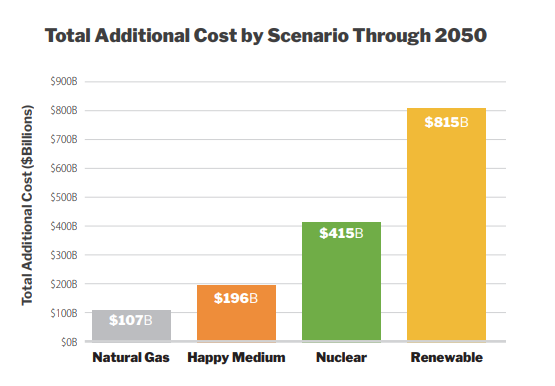
As stated, all of these energy paths would raise electricity prices, but the size of those increases varies widely. Under the Natural Gas scenario, prices rise by just 13 percent, while the Happy Medium approach increases prices by about 26.5 percent and the Nuclear scenario by 64.8 percent. By comparison, the Renewable scenario would be the most costly, driving electricity prices up by 126.4 percent, more than doubling what families and businesses pay for power.
Why the Renewable Scenario Costs so Much More
The report also lays out why exactly the renewable scenario is far more expensive than the others. The electric grid must constantly keep supply and demand in balance, every second of every day. When people turn on heaters, air conditioners, or plug in electric vehicles, power producers have to immediately increase electricity supply, or the grid risks brownouts or blackouts. That balance is easiest to maintain with “dispatchable” power sources like natural gas and nuclear, where generation can be ramped up or down as needed. Wind and solar, by contrast, depend on the weather, making it much harder to reliably match electricity supply with real-time demand.
While it is possible to address some of the reliability challenges of wind and solar power, doing so comes at a significant cost. Making these resources dependable requires large investments in battery storage and new transmission lines, as well as building far more wind and solar capacity than is usually needed so there is enough power available on calm or cloudy days. Much of that excess generation then has to be shut off when supply exceeds demand, which adds inefficiency and expense.
Reliability Implications
Reliability is the most important job of the electric grid, especially as our daily lives become more dependent on electricity for heating, transportation, communication, and work. A grid that relies too heavily on wind and solar is vulnerable to the weather, and when the wind isn’t blowing or the sun isn’t shining, that risk can turn into blackouts. Even with batteries and new transmission lines, a renewables-heavy system still struggles to consistently meet peak demand, increasing the risk of brownouts and blackouts. By contrast, the Nuclear, Natural Gas, and even the Happy Medium scenarios rely on power sources that can be turned on when needed, allowing the grid to meet peak demand and keep the lights on regardless of weather conditions. In practical terms, energy strategies that prioritize reliability help safeguard families, businesses, and critical services by ensuring the electric grid can deliver power consistently during periods of high demand, extreme weather, or system stress.
Emissions
When considering energy policies designed to cut greenhouse gas emissions, it’s important to ask whether the benefits are worth the cost. If reducing emissions comes at a price that outweighs the real-world gains, then the policy does not make sense to enact. To help make this kind of cost-benefit comparison, policymakers often rely on a metric known as the Social Cost of Carbon (SSC), which attempts to estimate the economic damage caused by emitting one additional ton of carbon dioxide. While this measure has clear limitations and should be treated cautiously, it can still be useful for showing when the costs of a proposed policy clearly outweigh its potential benefits.
The figure below shows the cost of reducing one ton of carbon dioxide in each year under each of the four scenarios and compares it to the SCC estimates established by the Biden administration. The graph below shows that the cost of reducing carbon dioxide emissions exceeds the Biden SCC in only the Renewable scenario, meaning the costs of reducing carbon dioxide emissions under the Renewable scenario exceed the benefits of doing so.

In short, this means that under the Renewable scenario the emissions reductions come at a cost greater than the climate benefits those estimates attempt to measure. It’s worth noting that MPI does not agree with the Biden administration’s estimates for the Social Cost of Carbon, but includes them here to show that even under those assumptions, the Renewable scenario still costs more than the climate benefits it claims to deliver.
Conclusion
In the end, the report makes clear that New England’s energy challenges are not just about reducing emissions, but about doing so in a way that people can actually afford and rely on. Policies that prioritize a renewables-only approach come with enormous costs, strain the electric grid, and increase the risk of outages, all while placing a heavy financial burden on families and businesses.
By contrast, energy strategies that incorporate reliable, dispatchable resources like natural gas and nuclear power can deliver meaningful emissions reductions without sacrificing affordability or grid stability.
Going forward, New England has choices, and it should apply common sense considerations of cost, reliability, and economic impact. Smart energy policy should keep the lights on, and avoid forcing residents to pay more for less dependable power.
Read or download the full report here.