
The United States has spent years trying to address housing affordability through subsidies, tax credits and government financed developments. Yet home prices and rents remain unaffordable for millions of Americans because policymakers have often avoided the central problem: there are simply not enough homes in the places where people want to live.
The recently-enacted 21st Century ROAD to Housing Act represents a partial recognition of that reality. The sweeping federal law includes more than 60 individual sections covering construction, financing, manufactured housing, zoning, federal grant programs, rural housing, community banks, institutional investors, and more.
From Maine Policy Institute’s perspective, the law is a mixed bag. Its strongest provisions remove government barriers that make housing harder and more expensive to build. Its weakest provisions expand subsidies, increase federal involvement, and restrict who may purchase private property.
Even the law’s positive reforms will take time to materialize. Housing projects take years to finance, permit, and construct. Federal agencies must also write rules and establish new programs before many provisions can operate. Any meaningful increase in supply, and any resulting effect on rents or prices, is therefore more likely to emerge gradually over several years.
What the Law Gets Right
The strongest portions of the ROAD to Housing Act recognize that housing cannot become broadly affordable unless it becomes easier and less expensive to build.
Encouraging Zoning and Permitting Reform
The act directs the Department of Housing and Urban Development to develop best practices for state and local housing policy.
Those recommendations include reducing parking mandates, lowering minimum lot sizes and setback requirements, permitting accessory dwelling units, allowing duplexes, and other small multifamily homes by right, establishing maximum review timelines and streamlining discretionary approval processes. The law also specifically addresses barriers to manufactured and modular housing. These recommendations correctly identify many of the regulations that restrict housing construction and are consistent with many of the problems MPI identified in our Under Construction housing report released last year.
Local zoning rules frequently prohibit less expensive housing types, require unnecessarily large lots, or force developers to provide parking spaces that residents may not need. Discretionary permitting processes also create uncertainty by allowing otherwise lawful projects to be delayed or rejected after developers have already invested substantial resources.
Federal guidelines will not, by themselves, change local zoning laws. The act also states that HUD cannot penalize a state or locality merely for declining to adopt the guidelines. Still, the law’s emphasis on reducing regulatory barriers represents an important shift away from treating housing affordability exclusively as a spending problem.
Expanding Manufactured and Modular Housing
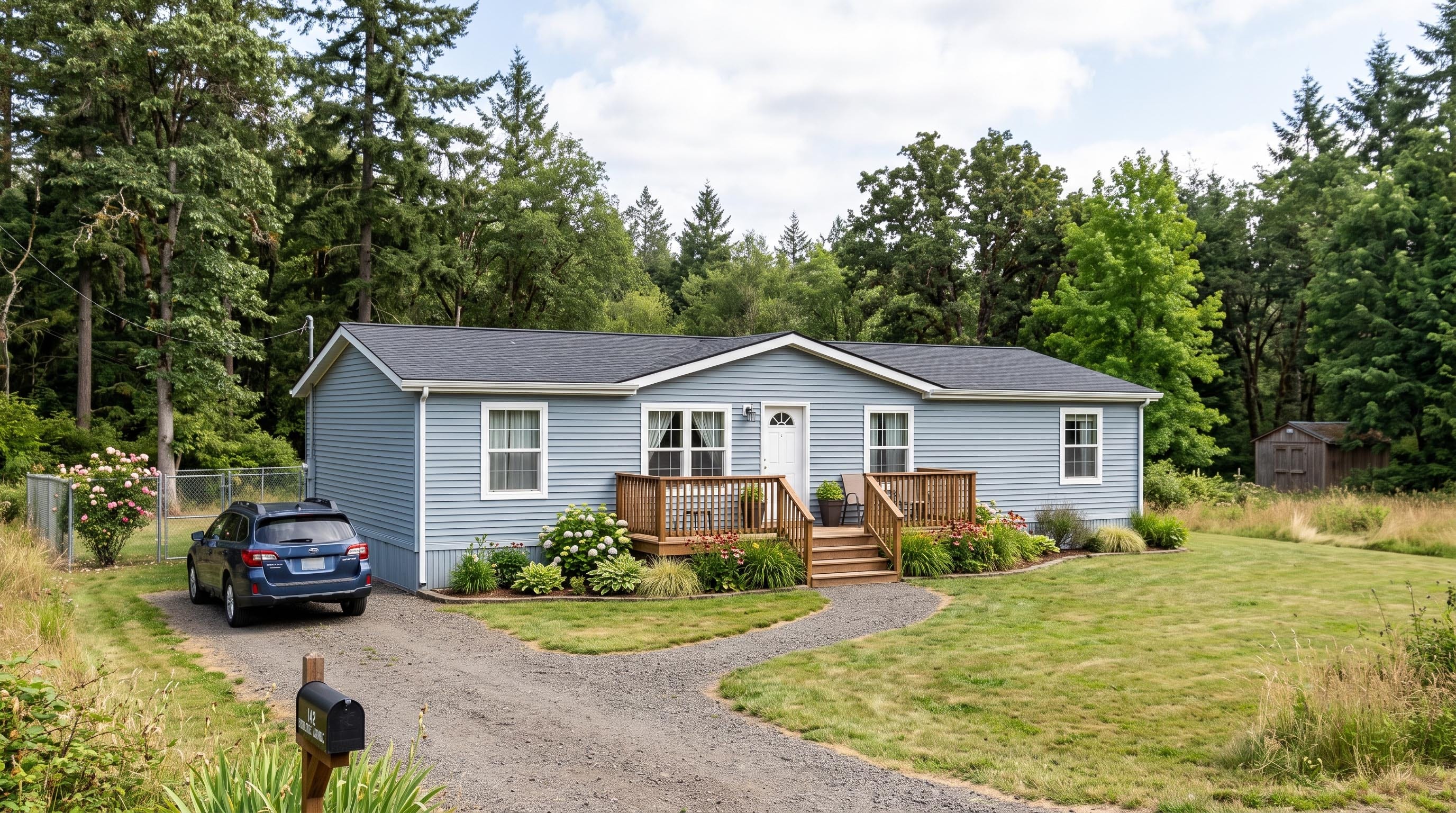
The law includes several reforms designed to encourage manufactured and modular housing, an issue MPI has advocated for and testified on for many years. These homes can be constructed in controlled factory settings, reducing delays caused by weather, labor shortages, and inconsistent worksite conditions. They can also cost substantially less than conventionally-constructed homes.
That makes the issue particularly relevant to Maine, where labor costs are high, construction seasons are limited, and many communities need housing that can be built affordably at a relatively small scale.
MPI has previously argued that manufactured housing can provide Maine residents with a less expensive alternative to traditional site-built homes and that municipalities should remove barriers preventing its development.
The federal act modernizes manufactured-housing definitions and financing rules, increases certain federal loan limits, and directs agencies to examine barriers facing modular-housing manufacturers. These reforms could expand consumer choice and allow builders to use more efficient construction methods.
Providing Community-Bank Regulatory Relief
The act’s community-bank provisions could also provide some indirect benefits for Maine’s housing market.
Smaller banks and credit unions play an important role in financing local home purchases, rehabilitation projects, and small-scale development. They are often more familiar with local property values, borrowers, and market conditions than large national lenders, making them especially important in rural communities and smaller towns. Yet these institutions must often comply with regulatory systems designed around the size, structure and risks of much larger financial firms.
The law includes changes involving bank examination cycles, deposit regulations, credit-union governance, and the formation of new community and rural financial institutions. These provisions are intended to reduce unnecessary administrative burdens and make it easier for smaller financial institutions to operate, expand, and serve their communities.
These changes will not directly produce new housing, and their effect will depend on how regulators implement them. However, reducing disproportionate compliance costs could allow local lenders to devote more staff time and capital to serving customers rather than navigating federal requirements. That could improve access to mortgages, renovation loans, and financing for smaller housing developments that may not attract the attention of large national banks.
Rewarding Homes That Actually Get Built
Another promising provision is the Build Now Act, which ties a portion of federal community-development funding to measurable increases in housing construction. Jurisdictions that improve their housing growth can receive additional funding, while some underperforming jurisdictions may see their allocations reduced.
This is not as effective as directly repealing restrictive zoning rules, reducing permitting delays, and removing the other government barriers that make housing harder and more expensive to build. Those reforms address the underlying problem more directly and should remain the priority.
Still, the provision represents an improvement over federal programs that reward communities for producing plans, conducting studies, or announcing housing goals without requiring meaningful results. As Maine knows well, homes proposed, permitted or funded on paper are not the same as homes that are actually completed and available for people to live in.
If the federal government is going to continue spending money on housing and community development, that funding should at least be directed toward jurisdictions that demonstrate real progress in producing homes.
Rewarding actual construction creates a stronger incentive for communities to move projects from the planning stage to completion rather than simply promising to address the shortage.
Streamlining Environmental Reviews
The law also allows certain smaller or lower-impact housing projects to skip a full federal environmental review. This includes some development on previously used land, the purchase of property for affordable housing, certain renovation projects and a few other situations. It also prevents agencies from requiring another review when a substantially similar review has already been completed for the same project and location.
Environmental protections can serve an important purpose, but requiring multiple agencies to review essentially the same project can add significant time and expense without providing any meaningful additional benefit. Each month of delay increases financing, labor, legal and administrative costs. Those costs are eventually reflected in higher rents or sale prices, and can even cause a project to be abandoned entirely.
Reducing unnecessary duplication should allow at least some federally-connected developments to move forward more quickly.
What the Law Gets Wrong

Unfortunately, the law also contains provisions that could undermine its own supply-oriented goals.
Restricting Institutional Home Purchases
The law’s most troubling provision restricts certain large institutional investors from purchasing additional existing single-family homes. The restriction generally applies to investors that directly or indirectly own at least 350 single-family homes, although the final law includes exemptions, including an important exception for qualifying build-to-rent properties. While targeting large investors may be politically popular and understandable to many frustrated homebuyers, public sympathy does not necessarily make the policy economically sound.
The fundamental problem is that preventing one category of buyer from purchasing existing homes does not create any additional housing; it simply changes which buyers are permitted to compete for the limited number of homes already available.
Institutional investors frequently purchase homes, renovate them and offer them as rentals. Those properties can provide an option for families that need the space of a single-family home but cannot, or do not want to, purchase one. Restricting investment could therefore reduce the supply of professionally-managed rental homes. In markets with already limited rental inventories, that could place additional upward pressure on rents.
Investment can also bring capital to vacant, foreclosed or deteriorating properties that require substantial repairs before they can be occupied. Large investors played such a role following the financial crisis, when they purchased foreclosed homes, converted many into rentals and helped stabilize distressed housing markets. Not every institutional purchase serves this purpose, but a blanket restriction risks discouraging the rehabilitation of properties that might otherwise remain underused or deteriorate further.
The policy also interferes with the rights of owners to sell their property to willing buyers and creates complicated questions about corporate structures, indirect ownership and enforcement.
Institutional purchases may increase competition for particular homes, but that competition is especially consequential because housing supply is constrained. The more effective response would be to allow builders to produce enough homes to meet demand.
Expanding Federal Grants and Subsidies
The act also creates or expands numerous federal grants, pilot programs and housing initiatives. Among other things, it authorizes a Whole-Home Repairs pilot, makes new affordable housing construction eligible for Community Development Block Grant funding, and creates programs connected to permitting, conversions, public housing and other housing activities.
The Whole-Home Repairs pilot, for example, would provide grants to qualifying homeowners and loans that may be forgiven for certain landlords. Participating landlords would be subject to conditions that include limits on rent increases for assisted units.
Although these programs may provide benefits to individual recipients, subsidies do not address the broader regulatory barriers limiting housing production.
In some cases, subsidies can increase demand for construction labor, materials, or housing without increasing productive capacity. That can raise prices and allow government programs to compete with private buyers and builders for already scarce resources.
Grant programs also empower federal agencies to decide which projects, organizations and communities receive assistance. That invites political influence, creates administrative costs, and can encourage local governments to pursue federal funding instead of adopting difficult but necessary zoning reforms.
The law specifies that it does not itself authorize additional funding, meaning that many programs will still depend on future congressional appropriations. That limits the immediate fiscal effect, but it does not eliminate the possibility of substantial future spending.
Government-Financed “Affordable Housing”
The act also allows Community Development Block Grant recipients to use up to 20 percent of certain funds for new affordable-housing construction.
Government-financed housing projects are often extraordinarily expensive on a per-unit basis. Projects may be subject to layers of federal, state, and local rules governing labor, procurement, environmental review, design, financing and tenant eligibility. Each requirement adds paperwork, professional fees, and delay.
By the time a subsidized development is completed, taxpayers may have spent far more per unit than a private builder would have needed to construct comparable housing. Government construction programs may produce highly visible projects and favorable political talking points, but they typically build too few homes to make a meaningful difference in a regional housing shortage.
A better approach would be to create conditions under which builders can produce naturally affordable housing without requiring a subsidy for every unit.
Affordable housing should mean housing that ordinary people can afford, not merely housing that the government has paid to designate as affordable.
A Better Road to Housing Affordability

The ROAD to Housing Act represents an important acknowledgment that housing affordability is fundamentally connected to supply.
Its best provisions reduce duplicative reviews, encourage zoning reform, expand construction options and address financing barriers. These policies could eventually allow more homes to be built at lower cost.
Its worst provisions move in the opposite direction. Restrictions on institutional buyers interfere with private transactions without adding supply, while new subsidies and grant programs expand government’s role in selecting projects and distributing benefits.
Congress should build on the market-oriented portions of the law.
Housing affordability will not be restored by deciding who may purchase property or by attaching a federal subsidy to an artificially-limited number of homes. It will be restored by allowing the market to build enough homes to meet demand.
The 21st Century ROAD to Housing Act takes some meaningful steps in that direction, but it also carries forward many of the same government interventions that contributed to making housing markets more complicated and expensive in the first place.
Subscribe to Maine Policy Institute on Substack