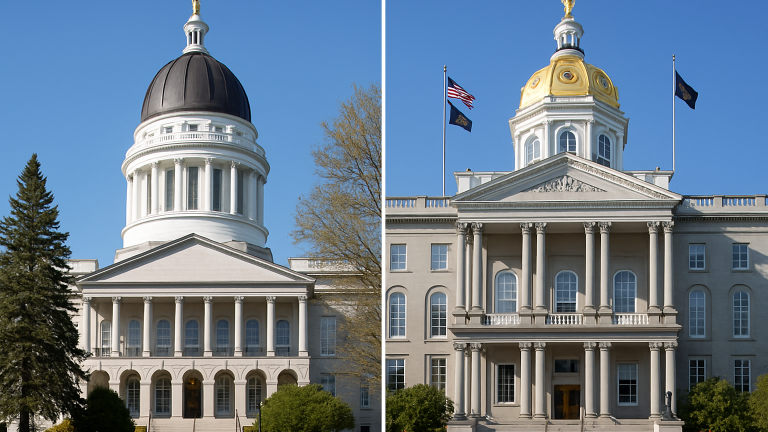
Maine and New Hampshire share a border, but when it comes to fiscal policy, taxation, and education, they live in two totally different worlds.
While Maine raises taxes and grows government to chase underwhelming outcomes, New Hampshire delivers superior services—especially in education—while maintaining no state sales or individual income taxes.
That contrast has never been sharper than during the 2025 budget cycle.
Budget Size: Similar Totals, Opposite Philosophies
Maine’s total state budget (including the General and Highway Funds) for the 2026–27 biennium is about $14.39 billion, compared to New Hampshire’s $15.9 billion. But how they spend those dollars—and how they raise them—couldn’t be more different.
- Maine’s General Fund was about $11.63 billion, accounting for 75% of state spending.
- Maine’s Highway Fund is another $2.76 billion.
- Meanwhile, New Hampshire’s General and Education Trust Funds make up only 40% ($6.4 billion) of its two-year budget.
This difference reflects not a disparity in need, but in design. New Hampshire relies on local control, federal pass-throughs, and user-based revenue while Maine centralizes power in Augusta and taxes accordingly.
Additionally, New Hampshire includes federal funds in their state budget calculations, which often make up about 32% of revenue, while Maine does not. While in this post we compare their overall budget calculations using the total numbers of each, it should be noted that if New Hampshire calculated their budget like Maine, it would be considered to be closer to $10.8 billion over the biennium.
Tax Burdens: Growth vs. Gouging
| Tax Type | New Hampshire | Maine |
| Income Tax | None (interest & dividends tax fully repealed in 2025) | Progressive 5.8 to 7.15% rates; proposal to adopt 9.15% “millionaire’s tax” carried over to the 2nd Session (LD 1089) |
| Corporate Tax | Corporate Income tax of 7.5% → goal of 7.0% by 2027 + BET 0.55% on economic activity/wages paid | Top corporate bracket is 8.93, with debate to further increase it to 10% (LD 1879, passed by the House and carried over on the Special Appropriations table by the Senate) |
| Payroll Tax | None | 1% PFML payroll tax starting 2025 |
| Sales Tax | None | 5.5% base, extending to new products in latest budget (digital streaming services) |
| Tax Competitiveness Ranking | 6th in the nation | 29th in the nation |
| State Tax Burden | 3rd lowest | 5th highest |
New Hampshire taxes less, yet still funds its core services even more than Maine. Maine, on the other hand, continues to impose new taxes on work, wages, and success, while struggling to deliver results.
Education: More Spending ≠ Better Outcomes
The most telling comparison may be in K–12 education.
- New Hampshire ranks among the top five states in math, reading, and science
- Maine ranks in the bottom ten in fourth-grade math and reading, despite spending only slightly less per student than its peers
| Metric | New Hampshire | Maine |
| NAEP Reading (Grade 4) | Ranked #4 | Ranked #40 |
| NAEP Math (Grade 4) | Ranked #4 | Ranked #41 |
| NAEP Reading (Grade 8) | Ranked #4 | Ranked #33 |
| NAEP Math (Grade 8) | Ranked #9 | Ranked #26 |
| Per-Pupil Spending | $21,898 | $19,310 |
| % of Avg. Income Spent on K–12 | 3.99% | 4.34% |
New Hampshire achieves far better educational results while spending just $2,600 more per student and consuming 0.35% less of the average taxpayer’s income. That’s not just better outcomes—that’s better efficiency.
How? By emphasizing local control, school choice, and flexible public funding, which allows for greater per-dollar responsibility to taxpayers, and overall, a more efficient education system with better results. Maine continues to support a centralized, bureaucratic model that demands more money without requiring better performance.
Legislative Priorities: Restraint vs. Expansion
New Hampshire (GOP Legislature + Gov. Ayotte):
- Passed a flat $15.9 billion budget that trims higher education but preserves K–12 funding with no tax hikes.
- Finalized repeal of the state’s last personal income tax.
- Continued phase-down of business tax rates.
- Protected property-tax-funded education with strong local discretion.
- Eliminated mandatory vehicle inspections starting in 2026.
Maine (Dem. Legislature + Gov. Mills):
- Enacted a record $11.63 billion General Fund budget, with a $2.76 billion Highway Fund, and a projected $637 million deficit by FY27.
- The corporate tax is 8.93%, possibly soon to be 10%.
- Approved a 1% payroll tax to fund a new Paid Family Leave program.
- Advanced a 2% surtax on income over $1 million (still under consideration).
- Increased the tax on tobacco from $2 to $3.50.
- Expanded the 5.5% state sales tax to streaming services and similar products.
- Increased the cannabis sales tax from 10% to 14%.
- Increased real estate transfer taxes on property sales greater than $1 million.
The contrast is clear: Even while having a biennial budget that is $3.27 billion more than Maine’s, New Hampshire focuses on more efficient and reliable revenue sources, while Maine does not.
Broader Impacts: Migration, Growth, and Revenue Stability
- Migration: New Hampshire has welcomed over 26,000 net in-migrants in 2020-2022. Meanwhile, Maine is estimated to have experienced a mere 12,000 population growth between 2020 and 2025, as talent increasingly drifts away from its high-tax environment.
- Housing & Property Revenue: NH’s low-tax posture has fueled real estate demand. Growing property values have increased local tax revenue without raising rates, allowing for expanded services without new burdens.
- Revenue Stability: New Hampshire’s Business Enterprise Tax—a small but stable levy on payroll and business activity—offers predictability to both the state and employers. Unlike the commonly used corporate income tax, which taxes the net profit of a company, the BET is a New Hampshire specific tax on business activity. Since payrolls are part of business activity, this technically indirectly taxes payroll, but not to the same degree or as directly as Maine’s payroll tax. Additionally, most small businesses are exempted from paying the BET. Maine’s heavy reliance on income and capital gains taxes creates higher year-to-year volatility.
What Maine Can Learn
- Stop taxing work and reward it. High income and payroll taxes hinder growth and deter talent.
- Tie spending to performance. Whether in education or social programs, more money doesn’t mean better results.
- Return control to local governments. New Hampshire proves that empowering towns and parents yields better outcomes.
- Institute tax triggers and guardrails. Every major new program should have a sunset clause or performance-based cap.
Additionally, one of the most unpredictable and growing costs in Maine’s budget is our state Medicaid (MaineCare) plan which, in 2023, represented around 32% of Maine’s total state budget. Additionally, Maine has a state medicaid expansion that covers noncitizens, and costs can be so unpredictable, an emergency supplement to the 2024-25 fiscal year was required to respond to an extra $118 million dollar shortfall in the MaineCare budget.
Meanwhile, New Hampshire as part of its budget ordered the state Department of Health and Human Services to submit a waiver to federal Medicaid standards, which would allow the state to further pursue work requirements for Medicaid, a policy for which Maine Republicans have repeatedly fought.
While the One Big Beautiful Bill already imposes work requirements at the federal level, New Hampshire would be allowed to impose even stricter requirements than the federal baseline, which is likely their intention. Further evidence supporting this conclusion is that in 2018, New Hampshire temporarily pursued a 25 hours per week work requirement, five hours more than the new federal standard.
The Bottom Line
New Hampshire is getting more for less. Maine is paying more to fall behind. While Concord tightens its belt and delivers excellence, Augusta piles on new taxes to cover old inefficiencies.
If we want Maine to thrive, we must follow the facts, not the feelings. New Hampshire isn’t lucky. It’s disciplined. And that discipline continues to pay off.