In his first year in office, in 2011, Gov. Paul LePage signed a highway budget that repealed Maine’s automatic fuel-tax increases, kept the existing fuel-tax rates in place, and removed the formula that would raise it each year unless the Legislature voted to stop it.
The repeal took effect on January 1, 2012. As a result, the gasoline excise tax in Maine has remained at 30 cents per gallon since July 2011. Our reconstruction of the original formula for the tax indicates that it would have risen by less than a penny per gallon in the first year. However, the annual increases would accumulate over time.
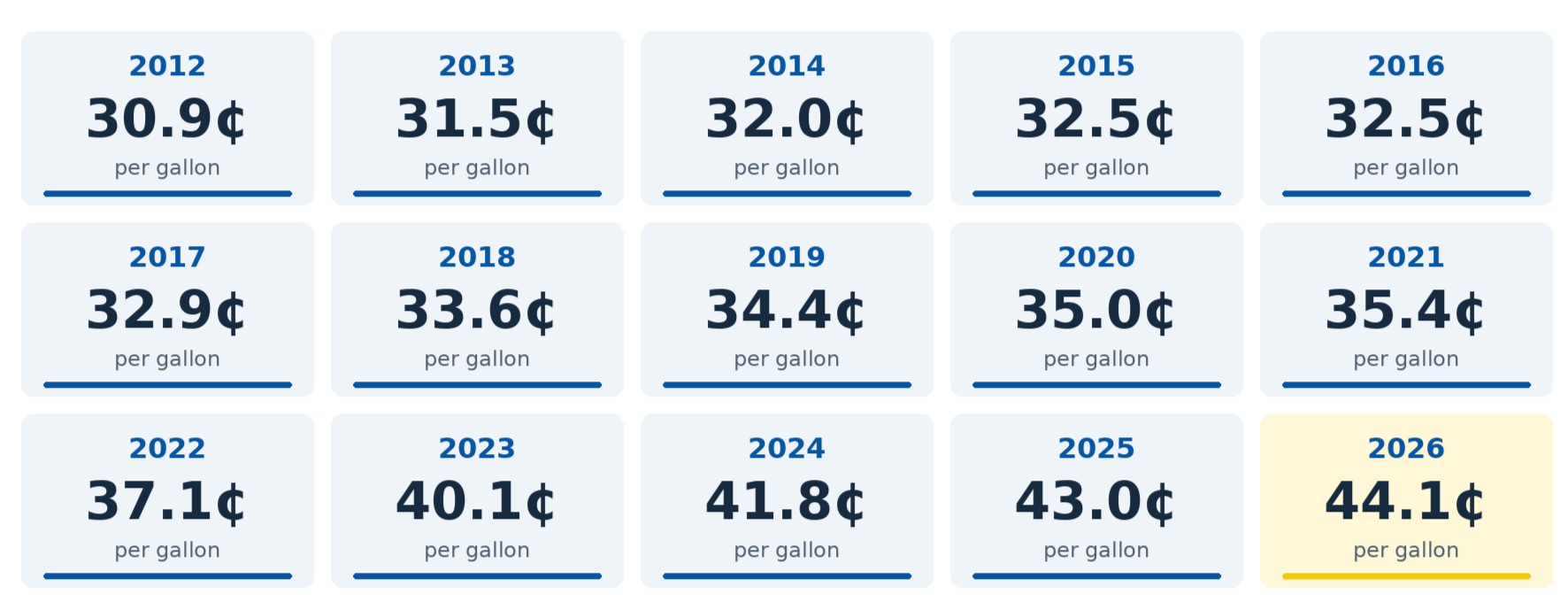
If all the increases envisioned in the original formula had been allowed to take effect, the gasoline excise tax would have risen to an estimated rate of 44.1 cents per gallon in July 2026. However, as a result of the LePage repeal, the tax has been steady at 30 cents, 14.1 cents per gallon lower than it would have been otherwise.
Across more than 14 years of gasoline purchases, MPI estimates that Maine’s gasoline tax collections between the time of the repeal and October 6, 2026, will be about $519 million less than they would have been if the excise tax had been allowed to continue automatically growing each year.
How Automatic Indexing Worked
Maine’s gasoline tax is a fixed charge per gallon, no matter the price shown on the price sign at the gas station. For example, under the current law, a driver purchasing 15 gallons of gas would pay $4.50 in state gasoline excise tax, regardless of where they went. Federal taxes and other fees are separate and not included in this analysis.
Since the repeal, Maine’s gasoline tax is free from any annual adjustments for inflation. Before the repeal, each year the state would compare the consumer prices for the preceding calendar year with the prices in the year before that. Based on that change, Maine would adjust its existing tax rate. Any new tax rate determined through that inflation adjustment would take effect on July 1 of the subsequent year and be rounded to the nearest tenth of a cent. Under that law, the inflation formula could increase the tax rate but not reduce the rate.
Any increase then becomes the starting point for any adjustment in the next year. For example, a hypothetical 3% adjustment would move a 30-cent tax rate to 30.9 cents. The next adjustment would then be based on 30.9 cents.
To estimate the effect of keeping that policy, we started with the actual 30-cent rate and applied the original formula year by year. We used the Bureau of Labor Statistics’ annual Consumer Price Index for All Urban Consumers, or CPI-U. This index tracks prices across a broad basket of goods and services, rather than gasoline prices alone.
The reconstructed rate reached 30.9 cents in July 2012, 35 cents in July 2020, 40.1 cents in July 2023, and 44.1 cents in July 2026. A 44.1-cent tax is 47% higher than a 30-cent tax. This means that all drivers in Maine would have been subject to a 47% higher gas tax had this automatic inflation law not be repealed.
What the Savings Mean for a Household
A 15-gallon fill up today would have cost consumers roughly $2.12 more under the original indexing policy; a 20-gallon fill up would have cost $2.82 more. While these amounts may not seem large, they are recurring for each fill up and they will add to the household’s overall annual transportation costs.
How much cost will be added annually would depend on how much you drive and what kind of gas mileage your vehicle gets. Taking the example of someone driving 15,000 miles in a year and having a vehicle that gets 25 miles per gallon, that equates to 600 gallons of gas. Taking 600 gallons and multiplying it by the 14.1-cent difference means $84.60 in annual savings. Consumers driving a combined total of 30,000 miles at the same fuel economy would save $169.20.
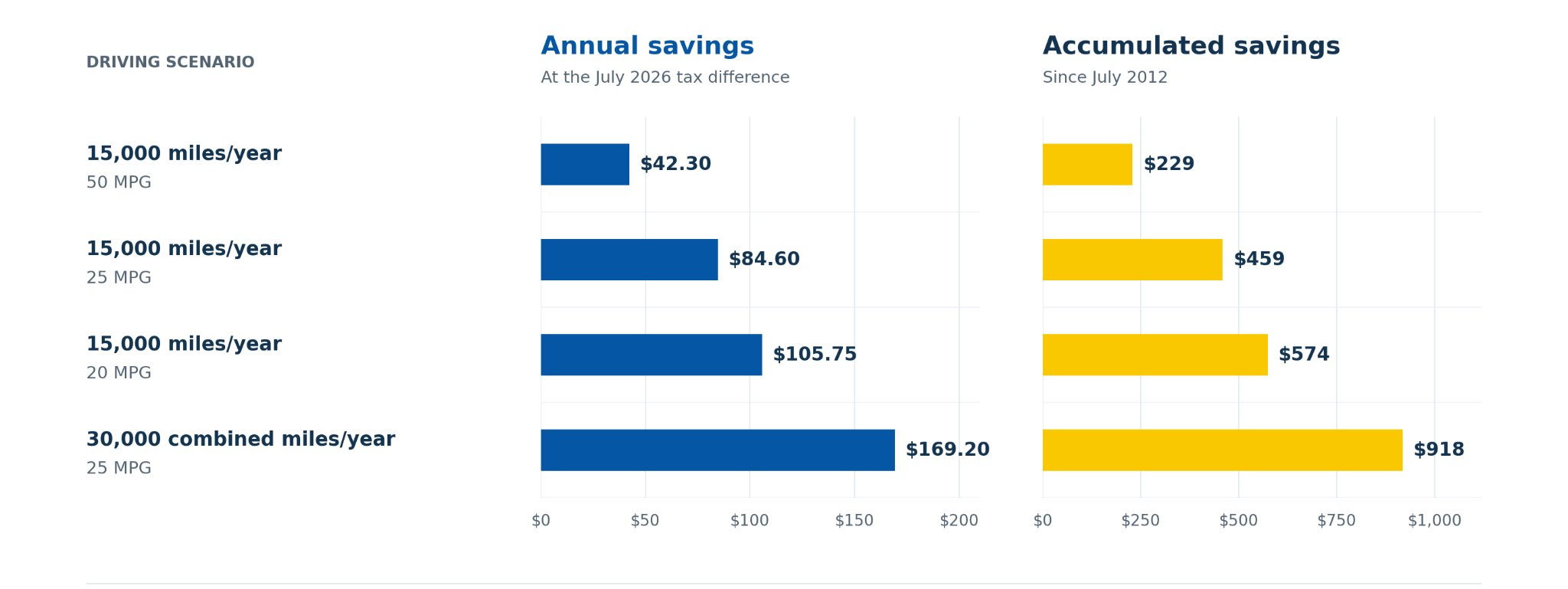
Of course, the savings could be substantially larger or smaller in the hypothetical examples if annual mileage is increased, fuel economy is worse, or gasoline is frequently purchased elsewhere. These calculations also illustrate the difference between annual and cumulative savings. In the example above, the annual savings are calculated using the difference for this past year, while the cumulative savings accounts for this year plus the smaller differences added in earlier years. Multiplying today’s $84.60 by every year since 2012 would overstate the total savings, because the avoided tax was much smaller at the beginning.
How the Statewide Estimate Reaches $519 Million
Calculating the avoided statewide taxes requires one more piece of needed information: the amount of taxable gasoline sold in Maine each year. We used the Federal Highway Administration’s annual Motor-Fuel Volume Taxed tables for 2012 through 2024.
For each year, we multiplied the reported gasoline volume by the difference between the actual tax and the modeled indexed tax. Because the hypothetical rate changed each July, the first part of the year had one tax difference and the second part had another. We accounted for the number of days at each rate, assuming gasoline sales were spread evenly throughout the year.
That produces about $368.7 million in avoided gasoline taxes from July 2012 through the end of 2024. To extend the estimate through October 6, 2026, we assumed annual gasoline sales remained at the 2024 level of 664,977,000 taxable gallons. The 2025 and 2026 portions therefore use assumed sales volumes rather than observed sales for those years. The estimate for 2025 alone represents 15.8% of all avoided gasoline taxes since July 2012, illustrating how annual increases can compound into a substantially higher tax burden over time.
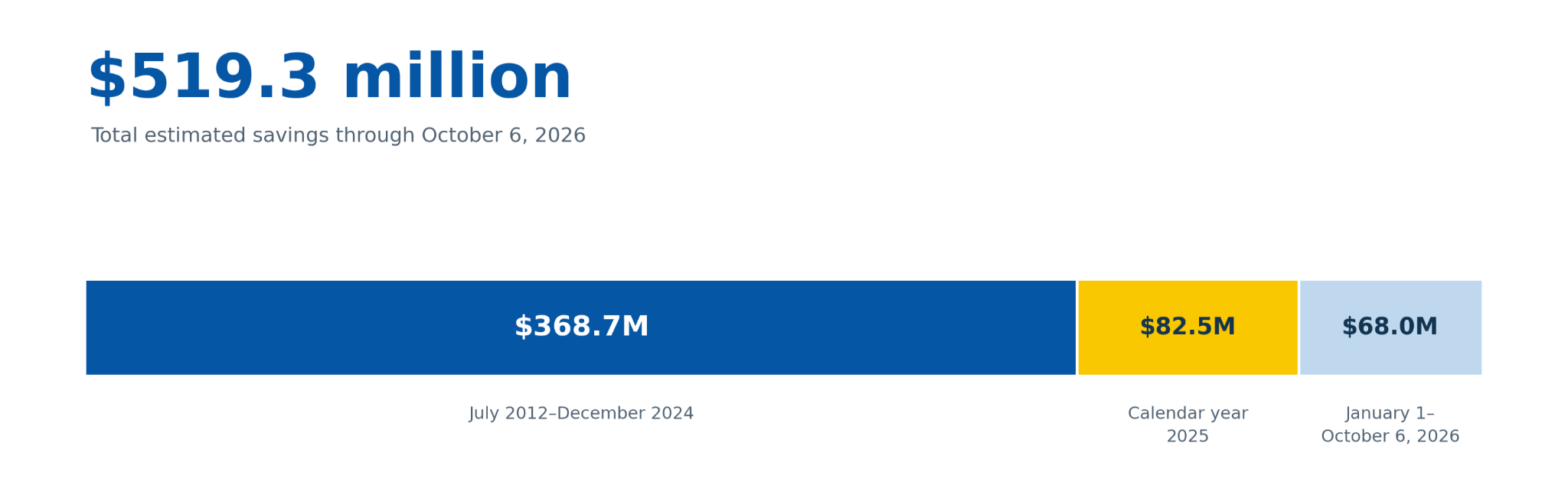
These totals are calculated from the original indexing formula, Bureau of Labor Statistics inflation data, and Federal Highway Administration gasoline volumes. Components are rounded independently. The unrounded total is $519,261,093.50. The $519.3 million figure adds each period’s avoided taxes. It does not apply today’s 14.1-cent difference to every gallon purchased since 2012.
Conclusion
The argument for indexing is that over time, inflation increases the costs of maintaining our roads and bridges. A fixed tax rate buys less and less over time, so it therefore makes sense to include automatic increases to preserve the purchasing power of that revenue.
But preserving the purchasing power of government revenue cannot be given higher priority than preserving the budgets of the people who have to pay it. When lawmakers want to increase revenue for transportation, they can assess the needs, scrutinize the spending, publicly debate whether additional revenue is justified, and then be required to vote to impose that increase. Requiring lawmakers to vote on tax increases makes them answerable to voters for those decisions, rather than allowing taxes to rise automatically through inflation indexing.
[P]reserving the purchasing power of government revenue cannot be given higher priority than preserving the budgets of the people who have to pay it.
By ending indexing, LePage and the Legislature ensured that Maine drivers, businesses, and visitors did not pay an estimated $500 million more in gasoline taxes. Drivers had more money in their budgets, and lawmakers will have to take responsibility for any future increase. Ending indexing on the gas tax shows how a single decision to restrain automatic tax growth can deliver lasting benefits for taxpayers. It deserves recognition for what it did for Maine drivers.
AI disclosure: AI assisted with research, modeling, calculations, and arithmetic checks. These are AI-assisted estimates based on the cited government data and stated assumptions, not official government findings or a complete human audit.