
The Portland Press Herald recently reported that a Siena Research Institute survey of 824 Maine residents found 85% of respondents viewed the availability of affordable housing negatively. Another 65% thought it was unlikely that people in their communities could afford quality housing. The survey, commissioned by the Maine Trust for Local News and conducted in July, found housing dissatisfaction across political parties, age groups, and regions.
So how did we get here? The answer is complicated but part of the answer lies in years of policy decisions that limited where housing could be built, increased the cost of building, and attempted to regulate affordability into existence.
Making housing more affordable will require Maine to reject its current trajectory and remove the rules that restrict supply, raise construction costs, and delay new homes. This has been done in other parts of the country, and Maine can do it, too.
The Shortage Begins Close to Home

In many Maine communities, local rules make it harder to build the homes people need. Local zoning rules like minimum lot sizes, setbacks and height limits, parking requirements, and restrictions on multifamily housing make it more expensive to develop land. These restrictions also limit the amount of new housing that can be built.
Maine Policy Institute’s 2025 Under Construction report documents how land-use zoning has been a significant variable in the housing affordability problem in Maine. The data show that in 2023, home values in Maine towns with land-use zoning are approximately 7% higher than in towns without such zoning. In a smaller sample of unzoned towns, an additional 10,000 square feet of required minimum lot size was associated with approximately 4% higher average home values.
While this doesn’t prove that land-use zoning is the sole cause of Maine’s housing affordability crisis, the basic dynamic is simple to understand: The larger the lot required to build a house, the fewer houses can be built on a given plot of land. When developers are restricted from building duplexes or apartments, and homeowners are restricted to single-family homes, less homes are built. This raises the cost of homes for everyone including first-time home buyers and young families.
Affordability Mandates Can Make the Shortage Worse
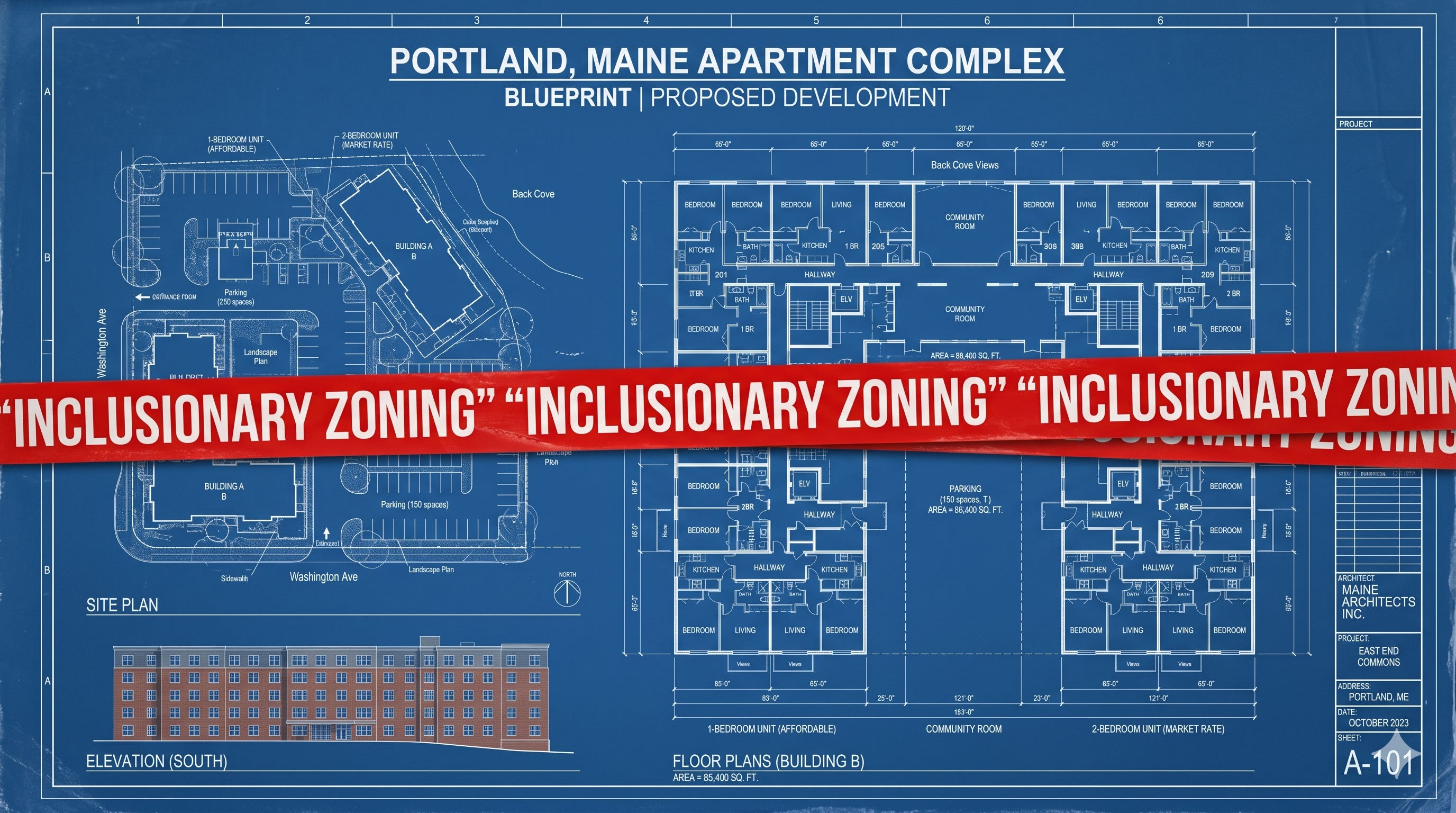
Portland shows the dangers of choosing affordability policies without regard for housing supply. The city adopted inclusionary zoning (IZ) in 2015, and added even more stringent IZ requirements last year. Developers of recently constructed or renovated buildings with at least 10 units must set aside 25 percent for income-qualified households or pay a fee instead. Our recent analysis shows that the requirement is so prohibitive it could render some housing impractical to build.
Portland’s rent-control policy, adopted in 2020, presents a similar problem. Rent control is billed as a way to protect existing tenants, but it has a demonstrated impact of reducing rental supply available to other renters. Research shows that when San Francisco expanded its rent control, the affected landlords reduced their rental housing supply by 15 percent. We don’t have an exact parallel estimate for Portland, but loss of housing supply should be something all Maine communities should consider before adopting such policies.
Our Under Construction report urges policymakers to be aware of how “affordability” policies affect housing supply. We should want rules that make additional homes easier to build, and avoid discouraging the kind of investment needed to add, and maintain, housing.
Augusta Has Added Costs and Managed Scarcity

Local restrictions are central to this story, but Augusta shapes the environment in which builders and property owners operate.
In 2019, the Legislature passed LD 1509, signed by Gov. Janet Mills, extending the statewide building and energy code’s application to smaller municipalities and requiring adopted model codes to remain within the two most recent editions. In 2022, LD 1656 added requirements to MaineHousing-funded construction, including compliance with specified green-building standards and the use of electric or other non-fossil fuel systems for primary heating, hot water, cooking, and cooling. These mandates restricted construction choices for the very projects intended to provide affordable housing.
Energy efficiency can reduce utility bills over time. But stricter requirements can also increase upfront construction costs. As Under Construction explains, a household trying to qualify for a mortgage must first be able to afford the purchase price. Policymakers should evaluate both sides of that tradeoff, rather than treating every additional requirement as costless.
The barriers extend beyond construction mandates.
Look no further than the January 2025 housing roadmap put forth by the Governor’s Office of Policy Innovation and the Future, Department of Economic and Community Development, and MaineHousing. This roadmap identified slow reviews, insufficient staffing, and unclear priorities at Department of Environmental Protection, Department of Transportation, and MaineHousing as obstacles to housing production. It also found that inconsistent local approval processes increase costs and uncertainty, discouraging developers from wanting to build in certain markets.
The report calls out environmental reviews under both the Natural Resources Protection Act and the Site Location of Development Act as contributing to delays and driving up housing costs. It calls for a streamlined review process, clearer review deadlines, the ability for developers to fund third-party reviews of their plans, and an expedited environmental review process for qualifying projects.
These delays carry real consequences. A project waiting for approval cannot house anyone, and uncertainty makes it harder to plan construction and secure financing. Augusta should make timely, predictable decisions — a basic expectation of its permitting system.
The Legislature has also enacted a series of rental-market regulations. LD 691 became law in 2023, generally prohibiting application fees while allowing limited screening charges. LD 701, also enacted in 2023, required 75 days’ notice for rent increases of 10% or more. In 2024, LD 1490 became law, adding fee-disclosure requirements and extending certain protections to mobile home parks.
Those laws may offer protections to renters, but they do not create additional homes. Added rental regulations can increase compliance costs and limit owners’ flexibility, making investment in rental housing less attractive and discouraging new construction. Adding new costs and restrictions to the rental market, while leaving barriers to new construction untouched, risks making Maine’s housing shortage even worse.
Maine Can Choose to Build

Austin, Texas offers a useful example of what happens when a housing market adds substantial supply.
The Federal Reserve Bank of Dallas recently reported that asking rents for Austin apartments have been declining for 26 consecutive months, dropping 7.7% through May 2025, compared to the August 2022 peak.
A March 2026 analysis, focused on falling Texas rents, noted that rates have fallen due to a construction boom that has created a supply that exceeds demand.
The HOME reforms passed in Austin in 2023 and 2024 also contributed to falling rates. These reforms allowed up to three units on a single-family-zoned property and a pathway for a single home on lots as small as 1,800 square feet. These reforms are likely only part of the success story in Austin, but they do show that Austin is willing to take bold steps to make room for housing, which in turn lowers costs.
Increasing supply would increase housing options for all Mainers across income levels. If everyone has more options, residents would have more power, forcing landlords to compete with one another for business. This competition among landlords would put downward pressure on rents across the state.
Maine doesn’t have to accept its current condition as permanent. There are any number of ways that towns and cities could remove barriers to make it easier to build homes, apartments, and additional units. Portland could stop imposing extraordinary costs on new development, and Augusta could stop adding construction mandates that put affordable housing further out of reach.
The frustration reflected in the latest Siena poll should push policymakers to reconsider the rules that helped create this shortage. Maine’s housing crisis was years in the making, but making it easier to build is a process we can start now.