
Maine’s ballot initiative process is often described as a direct democratic safeguard, a way for citizens to place pressing policy questions before the voters when the Legislature declines to do so.
But it also frequently functions as a pressure valve for interest groups attempting to bypass the scrutiny, hearings, fiscal analyses, and compromise that accompany the ordinary legislative process.
Now, as several petitions circulate that could qualify for the 2026 ballot, Mainers should take a careful look, not merely at the issues involved, but at the practical policy effects their passage could unleash.
Three citizen initiatives have been approved for signature gathering. Taken together, they represent sharply different visions of state responsibilities: rolling back commercial cannabis, restructuring school athletics and facilities, and directing lawmakers to construct a universal public healthcare system. Each proposal deserves measured scrutiny grounded in institutional reality, cost, and downstream effects, though to make the 2026 ballot, they’ll still need over 67,000 signatures, all by February 2026.
Let’s dive into what each proposal does.
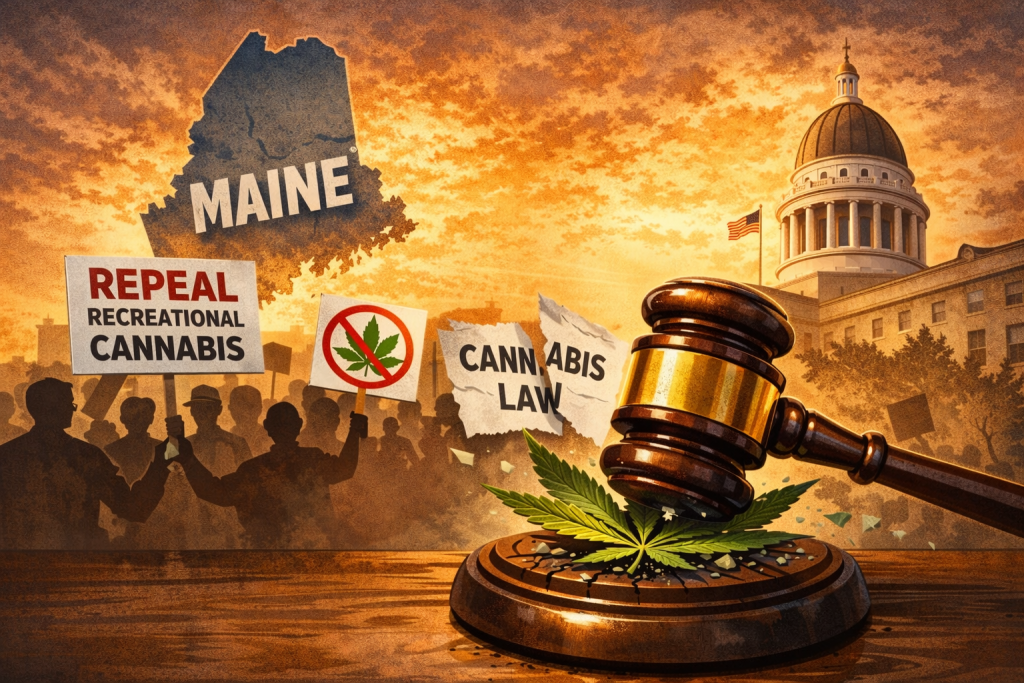
Repealing Recreational Cannabis: Public Safety or Support for the Illicit Market?
The first petition seeks to repeal the portion of Maine’s Cannabis Legalization Act authorizing recreational commercial cultivation, manufacturing, sales, and purchases.
Adults would retain the ability to personally use and transport cannabis, and up to 2½ ounces would remain legal. The measure would expedite registration for current licensees to shift into the medical program and impose new product testing requirements for medical cannabis, including mandatory screening for several chemical contaminants.
It is difficult to deny that Maine’s recreational rollout has been uneven. Licensing delays, local opt-in requirements, and inconsistent enforcement have limited access in many municipalities. Supporters of repeal will likely frame this as weakening Maine’s strong illicit marijuana market, increasing public safety, and supporting Maine’s more traditional industries. Yet the unintended consequence of reversing legalization, while keeping personal possession legal, is predictable: commercial supply would retreat underground.
Where legal markets shrink, illegal markets tend to expand. Prohibiting licensed retail and cultivation does not extinguish demand. It merely reassigns supply to unregulated actors who face none of the testing, age verification, or tax obligations imposed on legal businesses. Maine makes over $20 million a year in Cannabis tax revenue. While we currently have a revenue surplus, lawmakers are more likely to spend that money rather than remove an extra source of revenue. Policymakers should remember that Maine legalized cannabis in large part to address this very dynamic.
Even calling the measure a “return to medical only” understates the downstream effects. Enforcement challenges would intensify. Municipalities would again shoulder responsibility for policing unlicensed vendors. The lessons of prohibition, whether in alcohol, narcotics, or tobacco markets, suggest difficulty sustaining compliance when commercial activity remains illegal but personal possession is not.
Maine voters deserve clarity: this petition is not a narrow regulatory adjustment; it is a fundamental rollback of the state’s existing legal marketplace.

School Athletics, Facilities, and a New Legal Landscape
The second petition requires public schools to assign athletic teams as male, female, or co-ed, and to limit female teams to students “whose sex is female.” It would also require sex-separated athletic restrooms, locker rooms, and showers.
The proposal includes a private right of action and clarifies that such separation is not unlawful discrimination under state law, and arrives amid prolonged conflict over eligibility rules and student participation, driven in part by contradictions between state policy, local enforcement, and federal Title IX interpretation.
Supporters will likely argue the petition restores fairness and clarity; critics will warn it invites discrimination complaints and litigation. There is truth to both concerns: ambiguity in state-level guidance has led to inconsistent enforcement and contentious administrative decisions. But locking rules into the referendum statute raises serious questions:
- Will statutory mandates leave schools exposed to conflicting federal obligations?
- Will private lawsuits increase compliance costs for small districts already struggling with staffing and declining enrollment?
- How will schools navigate cases involving intersex students or students with documentation discrepancies?
However, there are multiple ongoing lawsuits revolving around this issue, and a state lawsuit that already required an emergency ruling by the United States Supreme Court to intervene. Thus, many Mainers might support this petition simply to stop the string of lawsuits costing the state and causing substantial friction between Maine and the federal government.

Universal Healthcare by Petition: A Mandate Without Funding
The third petition instructs the Legislature’s health committee to draft legislation establishing a publicly funded universal healthcare system for all Maine residents by 2028.
But the petition notably does not require passage of such a bill, nor identify revenue sources to finance it. The uploaded analysis highlights several escape valves: the committee could decline to act, the Legislature could refuse to pass a bill, or the proposal could die on the Special Appropriations table for lack of funding.
The scale of funding required strains credulity. Using Vermont’s modeling and adjusting for population, annual costs could reach roughly $3.7–$5.8 billion, potentially doubling Maine’s biennial budget of $11.6 billion. Current income, sales, and corporate tax revenues total roughly $9.5 billion biennially. A combination of steep increases in income and sales tax rates would likely be required to close the gap. If the revenue spent by Maine doubles, then most major tax rates would likely need to double to keep up, and that ignores the secondary effects, such as Mainers with a lower post-income tax income spending less on sales tax items.
Supporters of universal healthcare emphasize possible efficiencies and the moral imperative of expanded coverage. But voters deserve an honest fiscal outlook: a universal system implemented through the state budget would require unprecedented, broad-based tax increases. The petition does not require lawmakers to identify revenue sources or specify cost-containment strategies. Without those elements, even passage of the petition may amount to a symbolic gesture rather than a viable policy mandate.
Mainers frustrated by rising premiums, provider shortages, and rural healthcare closures may find the petition appealing in principle. But these structural issues do not disappear through directives alone. If voters want universal coverage, they must also confront the unavoidable tradeoffs: massive taxes, reduced provider autonomy, long implementation timelines, and the possibility of workforce shortages in the healthcare sector.
Ballot Policy Demands Budgetary and Institutional Honesty
These three petitions reflect deep public anxieties: frustration with commercial cannabis, conflict over school athletics rules, and dissatisfaction with healthcare access and affordability.
Yet policymaking by referendum can obscure the hardest questions, implementation logistics, unintended consequences, and fiscal feasibility.
Before signing these petitions, Mainers should consider:
- Does the policy require substantial tax increases or enforcement resources?
- Does the language allow for legislative flexibility and oversight?
- Does the measure conflict or comply with federal requirements?
- Are voters being asked to approve a symbolic statement rather than a workable policy?
Ballot initiatives are often drastic and unnuanced policy tools, and they frequently deny legislators the ability to debate, discuss, and amend potential laws before they go into effect. It’s important to consider the potential unintended consequences of any ballot question before voting to pass it. The coming petition debates deserve a sober assessment of the risks and responsibilities Mainers would be assuming.