“An Act to Establish Procedures for Restricting Access to State Property, Access to State Services and Communication with or Through State Entities”
Senator Carney, Representative Kuhn, and the distinguished members of the Committee on Judiciary, my name is Harris Van Pate, and I am a policy analyst at Maine Policy Institute, a nonprofit, nonpartisan organization that works to advance individual liberty and economic freedom in Maine. Thank you for the opportunity to submit testimony in opposition to LD 2150.
This bill represents a fundamental threat to Mainers’ civil liberties, enabling state agencies to silence dissent and restrict access to government services without due process or judicial oversight. While the bill is framed as a means of addressing safety and harassment on state property, it crosses a dangerous constitutional line and risks empowering government actors to suppress protected speech and political criticism.
If enacted, LD 2150 will not only undermine the rights of Mainers to petition their government, but it will also invite costly legal challenges and almost certainly be found unconstitutional by federal courts.
LD 2150 Is an Unconstitutional Prior Restraint on Speech
The U.S. Supreme Court has long held that any law enabling the government to restrict speech before judicial review is presumptively unconstitutional. In Near v. Minnesota (1931), the Court invalidated a law allowing the government to prohibit “scandalous” or “defamatory” publications, declaring it a violation of the First Amendment. Similarly, in Organization for a Better Austin v. Keefe (1971), the Court ruled that even persistent or unsettling pamphleteering in residential areas was constitutionally protected. LD 2150 allows agencies to impose pre-judicial access restrictions based on vague allegations of harassment or intimidation, placing it squarely in “prior restraint” territory.
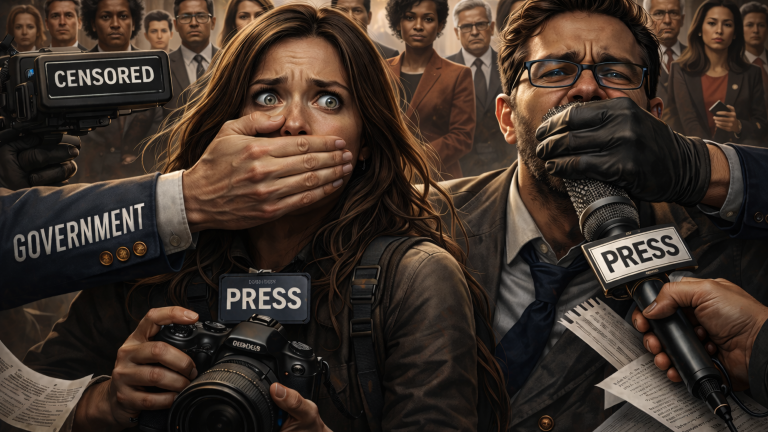
This bill attempts to undermine core constitutional rights, and does so through a complete misapplication of harassment laws to cases of government agencies. This is a structural power shift that would authorize state agencies to unilaterally censor and exclude citizens from public property and communications platforms without first proving wrongdoing in court.
LD 2150 Violates Due Process
The bill’s core mechanism, a 90-day access ban initiated solely by state officials, flips the constitutional sequence of enforcement and review. Under Catron v. City of St. Petersburg (11th Cir. 2013), such “ban now, review later” regimes were struck down as violations of due process. Citizens cannot be denied access to public services or property without prior opportunity to challenge the restrictions in court. LD 2150 proposes the opposite: the state acts first, and citizens must scramble to challenge the restrictions afterward.
The Constitution requires notice and a meaningful opportunity to be heard before a citizen is punished, not after.
The State Cannot Be a Harassment Victim Under Constitutional Doctrine
LD 2150 attempts to graft harassment law, a doctrine designed to protect private individuals, onto the government itself. But the state is not a private actor, and it cannot claim to suffer “fear” or “emotional distress” in the same sense as a person can. While an individual attorney at the Attorney General’s office could experience fear or harassment, that is not true for the office itself, which is a social construction.
As the Second Circuit ruled in Huminski v. Corsones, barring a citizen from public buildings based on critical or accusatory speech, absent actual threats or violence, violates the First Amendment. If passed, LD 2150 would enable the state to reframe political pressure, investigative journalism, and persistent criticism as “harassment,” thereby punishing constitutionally protected civic engagement.
The Bill Invites Viewpoint Discrimination and Vague Enforcement
LD 2150’s vague language, referring to “intimidation,” “confrontation,” and causing “fear,” grants broad discretion to government officials to punish disfavored viewpoints. Furthermore, since the 90-day window is when external review ever kicks in, this gives state agencies wide latitude to blanket approve their own harassment requests, regardless of validity. The concept of intimidating or causing fear to an entire agency or department, as shown earlier, doesn’t even make logical sense. Lastly, because confrontation is swept up in this bill, LD 2150 is a content-neutrality nightmare.
Critics, journalists, whistleblowers, and protesters, those most likely to be confrontational, are those who are undeniably going to be targeted. A journalist who agrees with the government would be intrinsically less confrontational than one who disagrees, meaning that dissent alone may lead to but-for causation of a journalist’s being barred from contacting the very agency they are attempting to report on.
There Is No Enforcement Gap to Justify This Overreach
The bill’s preamble claims a need for new tools due to an uptick in protests or agency concerns. But Maine already has:
- Trespass laws
- Disorderly conduct statutes
- Time/place/manner restrictions
- Civil harassment injunctions (with due process built in) (and that would already protect individual government employees worried about harassment)
LD 2150 invents a problem to justify a solution that reverses the citizen-government relationship, empowering unelected bureaucrats to exclude the public from their own government without court involvement.
Federal Precedent Indicates This Law Will Be Struck Down
The similarities to the 2005 Vermont case Huminski v. Corsones are striking—a case that is from the Second Circuit, which includes several parts of New England. In that case, Vermont officials attempted to ban a critic from courthouses based on “threatening” or “intimidating” speech, but the Second Circuit held that such exclusions are unconstitutional absent true threats or violence. Speech, even hostile, repetitive, accusatory, or unsettling, is protected in the Constitution of the United States as well as that of the state of Maine.
Courts have consistently ruled that exclusions based on speech, rather than true threats or criminal conduct, violate the First Amendment. The legal precedents outlined above make it clear that LD 2150 is on a collision course with constitutional protections.
If passed, this bill will not survive federal scrutiny and will expose Maine taxpayers to the cost of defending an indefensible law. Maine lost Libby v. Fecteau, another First Amendment case, just last year, where the Supreme Court enjoined the legislature’s First Amendment restrictions under its censure rule, in a 7-2 decision. Please do not set Maine up for two Supreme Court-level First Amendment losses in a row.
Conclusion: Reject This Unconstitutional Power Grab
LD 2150 undermines the First Amendment, violates due process, expands vague and discretionary government powers, and contradicts decades of federal case law. Most dangerously, it shifts the burden of proof from government to citizen, authorizing punishment without trial.
For the sake of civil liberty, the right to protest, speech, and the press, and the constitution itself, Maine Policy Institute urges this committee to vote “Ought Not To Pass” on LD 2150.
Thank you for your time and consideration.