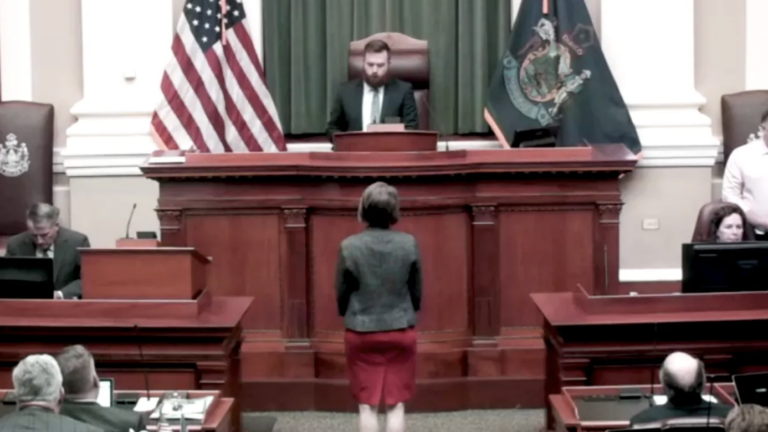
On the final day of the 2025 legislative session, the Maine House of Representatives voted to reinstate Rep. Laurel Libby’s right to speak and vote on the House floor, formally lifting the limits imposed on her earlier this year by her censure.
While the Legislature offered no explicit justification for this reversal, it was clearly influenced by the looming threat of a legal defeat. After all, the reinstatement came on the very last day of the session and only after a United States Supreme Court emergency injunction had already forced the House to allow her to vote. Additionally, while the vote was 115-16 to restore her speaking and voting rights, most of the Democrats who voted with the majority staged a walkout as she read a lengthy statement into the official House record on how she would have voted over the last few months of roll calls she was barred from participating in until the Supreme Court stepped in. Clearly, bygones are not bygones in Augusta.
But this move, while welcome, raises a critical question: Is Rep. Libby’s lawsuit now moot? And by that I mean, is she still likely to win on its merits?
Background
Rep. Libby was censured earlier in the session and barred from speaking or voting on the House floor, a move that triggered a federal lawsuit alleging constitutional violations. Her original legal complaint includes several key demands:
- A declaratory judgment that barring her from floor speech constituted unlawful retaliation in violation of her First and Fourteenth Amendment rights.
- A declaratory judgment that barring her from voting violated the Equal Protection Clause, Due Process Clause, and the Constitution’s Guarantee Clause.
- An injunction prohibiting the House from restricting her speech rights in the future.
- An injunction prohibiting the House from disregarding or nullifying her votes.
- An award of attorney’s fees, costs, and expenses.
- Any other legal or equitable relief the court deems just and proper.
With her speaking and voting rights restored, it may appear that her injury has been remedied. But legally and constitutionally, the story is far from over. Out of all her requested relief, only numbers 3 and 4 have been removed by the House’s restoring of her speaking and voting rights. She can still sue based on the historic rights violation she suffered, even if it is no longer present, and either request a declaratory judgment or nominal damages. Additionally, she has indicated she intends to continue with the suit, so the next question is what her chances of winning are.
Lasting Harm and Constitutional Stakes
Even though her silencing has ended, it caused real and arguably irreversible harm. Rep. Libby was barred from speaking or voting for months and missed hundreds of votes. Her votes during that time were not recorded and to this day remain absent from the official House roll calls. No effort has been made by House leadership to correct the record retroactively. As a result, her constituents were effectively unrepresented during key debates and votes. Even if they did repair the voting record, she was still unable to participate in floor debates, and there is nothing the House can do to undo that.
Moreover, from May 20 through June 25, Rep. Libby was only able to vote because the United States Supreme Court intervened with an emergency injunction, not because the House changed its policy. This matters because it underscores that the constitutional harm would have continued indefinitely without judicial intervention.
In several cases, her votes—made possible only by court order—affected the final outcome of actions taken in the Maine House of Representatives:
- House Roll Call 269 (June 2): Rep. Libby cast the deciding vote in favor of engrossing a bill to decriminalize possession of therapeutic psilocybin. While the bill ultimately failed, her vote brought it closer to passage than it would have been otherwise.
- LD 893 (June 2): A bill exempting nonprofit agricultural membership organizations from insurance mandates would have been killed on first reading, but Laurel Libby’s vote turned an Ought Not to Pass vote into a tie, allowing the bill to survive and be carried over to next year.
- LD 868 (June 13): Most ironically, Rep. Libby cast the deciding vote on one of the trans athlete bills this session. While LD 868 did not pass out of the House, she tied the vote on this bill’s Ought Not to Pass motion, forcing Democrats to table it until later, when some of her Republican colleagues were absent. It again failed to pass, but only by one vote. Another trans athlete measure, LD 233, passed the House, but failed in the Senate 14-21.
These examples prove that her vote had measurable and tangible impacts. Even without a new law resulting directly from her vote, the movement and status of bills is a traceable, concrete outcome that demonstrates continuing harm and justifies further legal review. These bills would have had different paths, destinations, and LD 893 might not have been allowed to pass next year because she voted against killing it. All of these votes would have been denied but for judicial intervention.
A Precedent from the U.S. Supreme Court
In Uzuegbunam v. Preczewski (2021), the U.S. Supreme Court ruled that even if the government ceases the offending conduct, plaintiffs may still pursue nominal damages to vindicate constitutional rights. In that case, a student at Georgia Gwinnett College distributed religious literature on a campus plaza and was silenced.
While the Georgia Gwinnett College court case was ongoing, the college revised its policy, abandoning the previous restrictions on on-campus speech. The trial court then dismissed the case for mootness, due to the injury disappearing, but the Supreme Court on appeal in an 8-1 ruling decided that even if the activity is gone, victims of constitutional rights violations may still pursue nominal damages (minor financial damages) in the absence of a need for an injunction. This allows courts to address constitutional violations and establish standing for past wrongdoings, and discourages even temporary violations of constitutional liberties.
That precedent is directly relevant here. Rep. Libby is still entitled to seek declaratory relief and nominal damages for the harm already done—and for the real risk that it could happen again without court intervention.
Conclusion
Some may view the Legislature’s move to reinstate Rep. Libby’s rights as an olive branch. More likely, it was an attempt to weaken her lawsuit and avoid a constitutional reckoning. But the damage has been done. Her constituents were silenced, her votes erased, and her rights infringed.
The courts should not allow elected representatives to be muzzled and stripped of their duties by legislative majorities for political reasons. This case presents a rare opportunity to set clear constitutional boundaries on legislative discipline and protect the core principles of representative government in Maine.
Whether or not you agree with Rep. Libby’s politics, her lawsuit raises issues that should concern every Mainer. The ability of duly-elected representatives to speak and vote freely is not just a legislative norm—it is a constitutional necessity. Hopefully, when a court issues a final ruling on this case, the Maine Legislature will begin to take the rights of elected representatives and their constituents seriously.