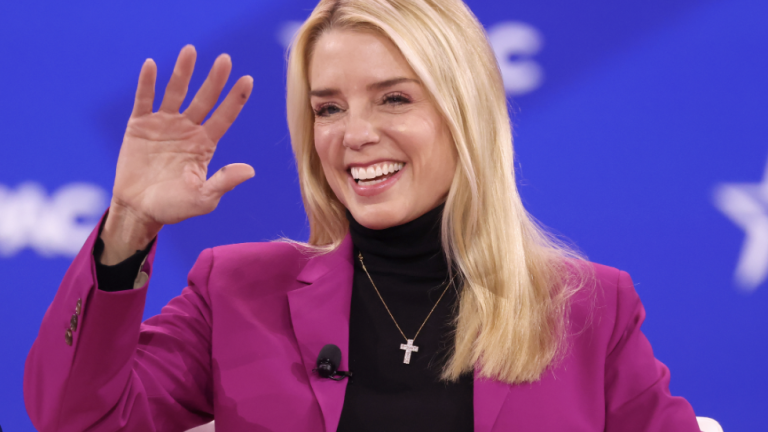
Last week, United States Attorney General Pam Bondi suggested that the Department of Justice under President Trump would “target” and “go after” individuals engaging in “hate speech” in response to public reactions following the tragic killing of conservative political activist Charlie Kirk.
Understandably, many were outraged by the celebration or mockery of Kirk’s death that spread across social media. But Bondi’s remarks raise serious concerns, not just about prosecutorial overreach, but about the persistent public misunderstanding of First Amendment law. Despite what Bondi claimed, in the United States, there is no unprotected legal category called “hate speech.” And there never has been.
What the Law Actually Says
Speech that is hateful, offensive, or cruel is not banned under American law. The First Amendment does not allow the government to regulate ideas simply because they are unpopular or upsetting. The U.S. Supreme Court has consistently reaffirmed that content-based speech restrictions are unconstitutional unless the speech falls into one of a few, narrowly defined exceptions.
Here are the real legal limits to free speech:
- Incitement to Imminent Lawless Action: Speech intended to cause immediate illegal acts, and likely to do so, is not protected (Brandenburg v. Ohio, 1969).
- True Threats: Statements expressing a serious intent to commit violence, with at least reckless disregard, can be prosecuted (Virginia v. Black, 2003; Counterman v. Colorado, 2023).
- Fighting Words: Direct, face-to-face insults that are likely to provoke an immediate violent response (Chaplinsky v. New Hampshire, 1942). This doctrine is almost never upheld today.
- Obscenity and Child Exploitation: Explicit content that meets strict legal tests or involves minors is not protected (New York v. Ferber, 1982).
- Defamation: False statements of fact that harm a person’s reputation, especially with malice or reckless disregard for the truth (New York Times v. Sullivan, 1964).
- Speech Integral to Criminal Conduct: Fraud, blackmail, and solicitation of crimes are all examples of speech that can be punished (Giboney v. Empire Storage & Ice Co., 1949).
- Certain kinds of Commercial Speech: Commercial speech can be regulated if it is misleading, concerns illegal activity, or the regulation furthers an important government interest and is substantially related to that interest (Central Hudson Gas & Electric Corp. v. Public Service Commission, 1980).
None of these categories is defined by the viewpoint expressed. That matters. Even vile or offensive speech remains protected unless it crosses those narrow legal lines.
Why This Matters
After criticism from both Tucker Carlson and Justice Sotomayor, Bondi clarified that she does not plan to prosecute people for merely expressing hateful opinions. Instead, she said her comments referred to threats and incitement, both already covered under existing law.
But her original statement wasn’t just a communications error. It played into a common and dangerous belief that the government can regulate “hate speech” simply because it’s hurtful or extreme. That idea may be common in other countries, but it has no place in American law.
If taken seriously, Bondi’s original framing could have a chilling effect. People may begin to self-censor legitimate political or cultural criticism for fear of crossing a vague, undefined line. Worse, a future administration might use such a policy as a pretext to suppress dissenting views, and we should all be very concerned when federal authorities consider limiting constitutional rights, even temporarily.
A Teachable Moment
What happened to Charlie Kirk was a tragedy, and the callous reaction from some corners of the internet deserves moral condemnation. But the remedy for hateful speech is not censorship or prosecution; it’s more speech, better arguments, and a stronger civil society. Censorship of even outrageous opinions is undoubtedly not what Charlie Kirk would’ve wanted.
Pam Bondi’s comments should be a wake-up call for policymakers, journalists, and citizens alike. We don’t need new laws to criminalize offensive speech. We need a deeper understanding of the principles that make America different from every other country in the world.
At a time when both political parties have shown a willingness to bend constitutional protections for short-term gain, defending the First Amendment is more important than ever.