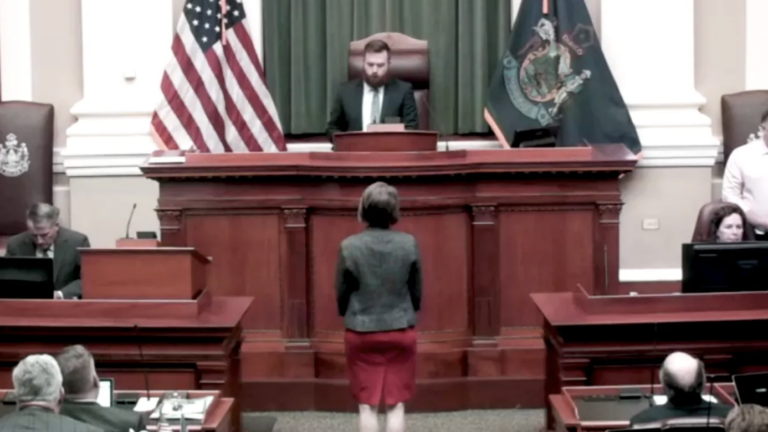
Review of the Background of the Laurel Libby Case
As covered extensively in previous blog posts, Maine State Rep. Laurel Libby was barred from voting and speaking on the House floor after making a Facebook post criticizing a local high school for allowing a trans athlete to compete on girls’ school sports teams. In the post, she included a picture of the athlete and their preferred first name, both taken from a local newspaper.
In response to the House censuring her, Libby filed suit in federal court seeking a preliminary injunction to restore her rights to vote and speak as an elected official. House Speaker Fecteau responded that Rep. Libby has the ability to lift the censure herself if she apologizes for making the post. However, so far she has refused, as many objected that she either did nothing wrong or that an apology might be seen as her backing down from her strong stance on the issue. When a Rhode Island federal trial court judge denied Rep. Libby’s request, she appealed to the First Circuit but was again rebuffed, though she notably narrowed her claim on appeal to focus solely on her voting rights as a legislator.
Eventually, Libby brought her case before the U.S. Supreme Court. The result was a striking rebuke to the Maine House of Representatives: the Court issued a 7-2 ruling granting a preliminary injunction, allowing Rep. Libby to vote again on the House floor. While the case’s outcome remains pending in the lower court, this decision signals a strong warning to state officials that punitive silencing of elected representatives may cross constitutional lines.
Analysis of the Supreme Court Decision and Its Effects
Though the Court did not issue a majority opinion, only two justices—Sotomayor and Jackson—publicly dissented. This means the other seven justices likely found merit in Libby’s claim that excluding an elected representative from voting in her official capacity raises serious constitutional concerns. The ruling is limited in scope—it grants temporary relief while the lower courts continue to adjudicate the broader claims—but the implications are sweeping. It sets a powerful precedent that legislative bodies may not hide behind internal rules to suppress fundamental democratic rights.
The ruling also pressures the judiciary in the First Federal Circuit, which covers Maine and most of New England. While the trial court case proceeds, the fact that a strong Supreme Court majority intervened early suggests that any lower court ruling against Libby may be swiftly appealed—and potentially overturned.
Justice Kagan Joins the Majority
One of the most intriguing aspects of the decision is that Justice Elena Kagan, a liberal stalwart, apparently sided with the majority. Justices Sotomayor and Jackson both dissented, stating that they would not have granted a preliminary injunction in this case, but Justice Kagan did not join in the dissenting opinions. While she is not known for aligning with the Court’s conservative wing, her judicial philosophy does reflect a nuanced stance on free expression, particularly where state action threatens ideological neutrality.
In Iancu v. Brunetti (2019), Kagan authored a 6-3 opinion striking down a federal law prohibiting registration of “immoral or scandalous” trademarks, emphasizing that the government cannot suppress speech based on its controversial or unpopular nature. In Reed v. Town of Gilbert (2015), although she concurred separately, Kagan rejected absolutist interpretations of free speech but expressed concern about laws that risk ideological suppression, aligning closely with the concerns raised in Libby’s case.
Also notable is that Justice Kagan authored the minority opinion in the controversial 2019 five-to-four decision Rucho v. Common Cause, which concerned whether courts can regulate partisan gerrymandering. In justifying her dissenting opinion there, she quoted the earlier case California Democratic Party v. Jones “Representative democracy is ‘unimaginable without the ability of citizens to band together in [support of] candidates who espouse their political views.’” The Libby case, of course, does not just limit who the people of Maine can support in office, but directly restricts Rep Libby’s ability to espouse her and her constituents’ political views.
Thus, while we can’t be certain why Justice Kagan split with the other liberal justices, the concerns in Rep. Libby’s case related to unpopular political speech, ideological expression, and her being punished for expressing political views all may have played a part in her decision.
Kagan has shown a nuanced stance on protecting unpopular political speech, though not hardline. Thus, her willingness to join the Libby majority suggests a recognition that the Maine House’s actions posed a serious risk of suppressing representative speech—speech essential to democratic governance.
Justice Jackson’s Dissent and Procedural Role
Although Justice Ketanji Brown Jackson dissented from the ruling, she actually played a pivotal role in elevating the issue to the full Court. As the Supreme Court Justice overseeing the First Circuit, Jackson could have unilaterally denied the emergency appeal. Instead, she referred it to the full Court, demonstrating a commendable commitment to judicial process. Her procedural deference enabled the majority to weigh in and provide necessary relief—an act that, ironically, helped Libby prevail despite Jackson’s substantive disagreement.
This reflects a principle-based approach to judicial duty: upholding the Court’s institutional legitimacy while recognizing that certain questions demand broader input. Even in dissent, Justice Jackson’s actions underscore the gravity of the constitutional issues at stake.
Furthermore, her dissent implies that she might actually rule for Rep. Libby if the whole case were to reach the Supreme Court, as her dissent entirely rested on the need for a higher standard for preliminary injunctions by the nation’s highest court, writing that, “It is certainly possible that the applicants have the better of the arguments on the merits of their claims. But without binding precedent on any of these issues, their right to relief is not clear, let alone indisputably so.” This is the only written dissenting opinion on the case, and it even shows skepticism of Maine’s legal defense.
Conclusion: What’s Next?
The legal proceedings in Rep. Libby’s case are far from over. Her broader claims, including the right to speak on the House floor, remain active in the trial court. Yet the Supreme Court’s ruling sets the tone, signaling to Maine judges that excluding duly elected lawmakers from their official duties will face significant constitutional scrutiny, especially if done as retaliation for clearly protected political speech.
This case also invites legislative reconsideration. The Maine House should revisit any policies that enable political retaliation under the guise of decorum. Ensuring that all representatives, regardless of viewpoint, can fully participate in the legislative process is essential to a functioning republic. At a time when political division is rising, it is essential to remember that, regardless of politics, the people’s voice, expressed through their elected representatives, must not be silenced.