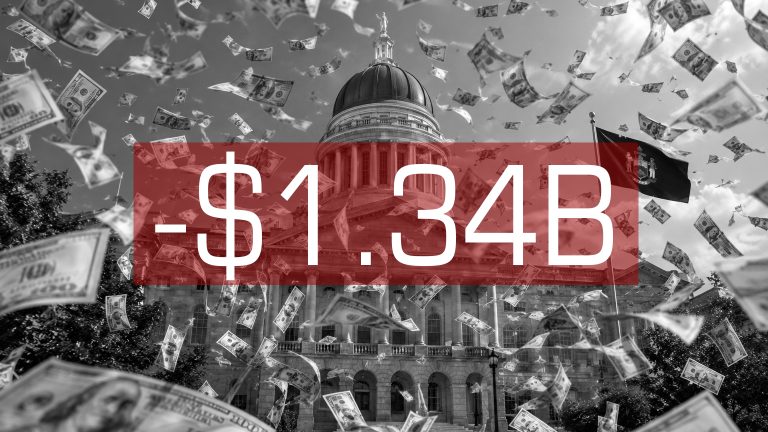
A recent report has shown that Maine’s next governor and legislature will be faced with a budget problem that’s been years in the making.
The report shows that years of reckless spending have led to a predicted $1 billion budget gap between Maine’s projected General Fund revenue and the cost of its existing commitments.
The size of that gap should be no surprise to anyone who’s been paying attention. State spending has grown rapidly in recent years, with lawmakers repeatedly using temporary revenues and one-time funding to sustain permanent spending increases.
The question now is not whether Maine has a spending problem, but how policymakers intend to address it. Thankfully, months before this forecast was released, the Maine Policy Institute began putting together its latest Maine Policy Blueprint. We included for the first time a dedicated section about the budget, with the goal of identifying $1 billion in potential reductions. Thanks to this edition, the next administration will already have a series of proposals for bringing spending under control.
What the Budget Gap Means

The forecast report released on September 30 by the state estimates a $1.085 billion General Fund gap in the two-year budget period beginning July 1, 2027 and running through June 30, 2029. A separate Highway Fund gap of $256.7 million brings the total projected structural gap to approximately $1.34 billion. This represents the difference between projected revenue and the estimated cost of maintaining current services required under existing law.
The gap projection is a baseline and the figures used for revenue estimates, cost of current services, and other considerations could change. Nonetheless, the underlying presumed imbalance is substantial. Projected General Fund appropriations rise from approximately $12 billion in the current biennium to $13.26 billion in the next, while projected revenue for the next biennium totals approximately $12.17 billion. Maine has committed itself to a level of spending that projected revenue simply cannot sustain.
This means that in the upcoming 133rd legislature, simply carrying existing programs forward will require substantial budget adjustments, even before the governor or legislature considers new initiatives. Any proposal to expand spending will therefore need to account for both its own cost and the commitments Maine already lacks sufficient projected revenue to cover.
Augusta Had Plenty of Warning
Two years ago, the state’s four-year forecast projected a $636.7 million General Fund structural gap. This means the new General Fund projection is roughly 70 percent larger than even that large number. This shows that significant fiscal pressures were evident well before this report was released, and lawmakers continued to add commitments despite serious warnings about the impending budget crisis.
Maine Policy Institute (MPI) has long warned about the consequences of persistent, unsustainable state spending. In a 2019 press release responding to an earlier Mills administration budget, CEO Matt Gagnon warned, “It will take us back to the days of uncontrolled spending and busted budgets, and will set the stage for future tax increases.” With the benefit of hindsight, that warning proved accurate, and in the waning days of the Mills administration, it looks truer than ever. State budgets since then have only compounded the same underlying spending pressures.
More recently, MPI raised concerns about the increased spending obligations taken on in the supplemental budget and the reliance on reserve funds to cover the costs associated with it, because every new, recurring obligation adds to the baseline spending level that future budgets will have to support.
In addition to MPI, certain legislators saw this shortfall coming. In his September 25 Portland Press Herald column, “Mainers should brace for a state budget bombshell,” Rep. Ken Fredette, R-Newport, predicted correctly that there would be a significant, impending budget problem, fully aware that the official forecast of the size of the problem would be announced five days later.
Fredette, a member of the Appropriations Committee, attempted to prepare Mainers for the news that the combined General Fund and Highway Fund budgets would have a gap approaching $1 billion, largely because of MaineCare costs driven up by utilization and medical prices, as well as increased enrollment. Notably, the combined projection exceeded Fredette’s prediction by approximately $340 million.
Spending Cannot Keep Outrunning Revenue

The forecast identifies approximately $345 million in additional MaineCare costs, and another $280.7 million to maintain the state’s 55 percent share of K–12 education funding. It also includes approximately $150.6 million additional funding for preschool special education responsibilities. Although some projected costs declined, those savings fall far short of offsetting the overall increase in spending.
This forecast assumes that all enacted tax changes, including the 2% income surcharge, are in effect. However, despite higher taxes, there remains this massive budgetary shortfall that we cannot simply mask with reserves, one-time transfers, or temporary budget maneuvers.
By law, the next governor will be required to submit a balanced budget proposal by February 5, 2027. At that time, the next Legislature will need to choose which commitments to Maine people they will sustain, and which they will reform. Rather than make further demands on taxpayers in the form of more tax increases, legislators should examine ways in which they can reduce recurring spending in order to correct this imbalance.
MPI Has Already Started That Work

The 2026 Maine Policy Blueprint was developed to provide practical reforms for the next governor and the 133rd Legislature. Our decision to add a dedicated budget section, and to aim for $1 billion in savings, reflected concerns about the direction of state spending before the latest forecast confirmed the scale of the next budget challenge.
The finished Blueprint identifies at least $1.03 billion in estimated biennial savings across almost every department and agency, including reducing long-vacant nonessential positions, consolidating office space, reviewing Department of Health and Human Services contracts and administrative overhead, cutting unnecessary programs completely, and restructuring programs that have grown beyond the state’s core duties, in addition to other targeted reductions and reforms.
These are only estimates, and lawmakers should review the tradeoffs involved in each proposal carefully, including whether they would require statutory changes or have to be implemented slowly. But the 2026 Blueprint provides an excellent starting point for addressing the shortfalls present in the budget.
Maine’s fiscal problems cannot and should not be treated with another temporary patch in the next budget. Recurring obligations need to be brought in line with sustainable revenue. Programs need to justify their cost. MPI’s Blueprint provides the next governor and Legislature with concrete proposals to begin that work.